
Florida Home Buying Guide · Closing Costs
Title Insurance in Florida: Owner vs. Lender Policy, Who Pays, and Every Red Flag to Know Before You Sign
Title insurance is one of those line items at closing that most buyers just sign off on without really knowing what they’re getting. Let’s change that.
Owner’s Policy vs. Lender’s Policy: What’s Actually the Difference?
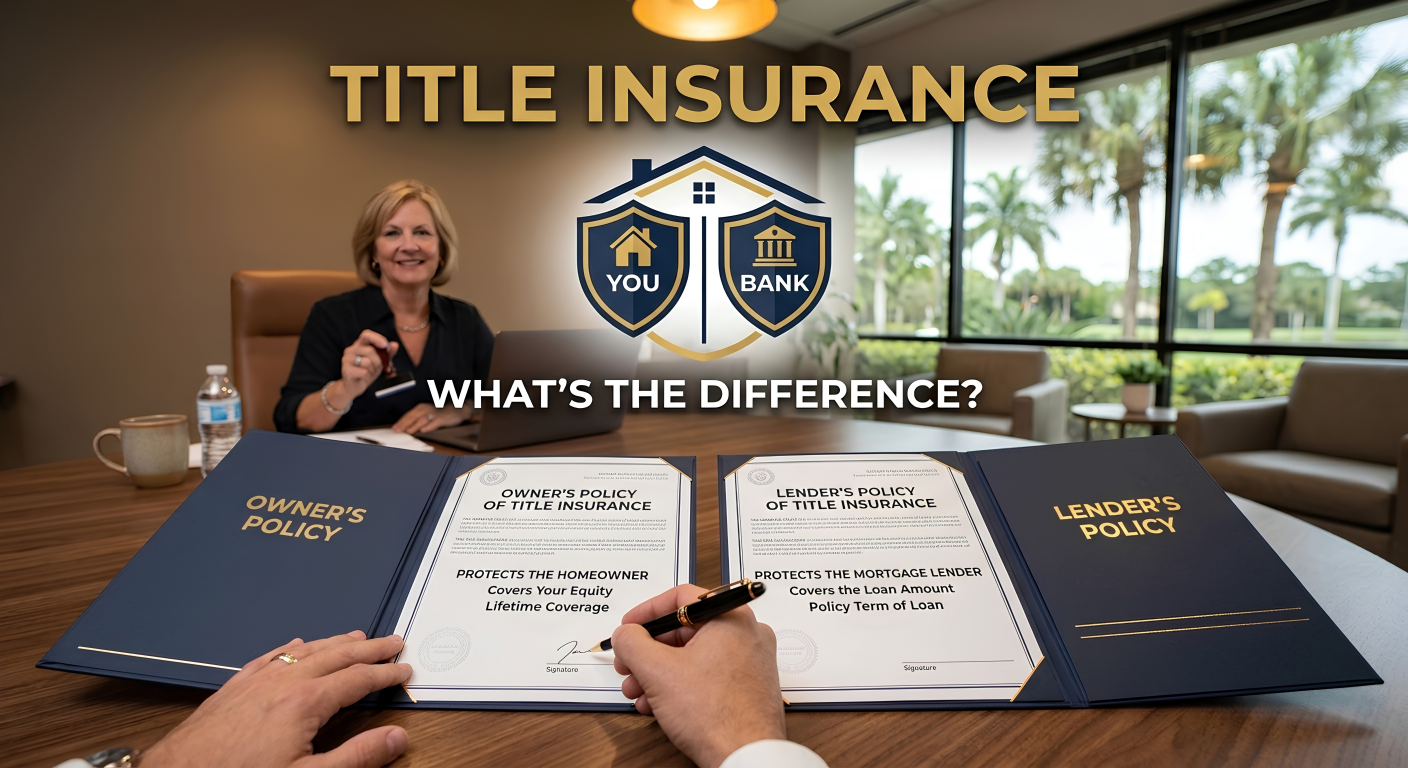
Title insurance in Florida comes in two forms — and they protect two completely different parties. Many buyers don’t realize until after closing that their lender’s policy offers them zero personal protection.
- Covers you for the full purchase price
- Protects you as long as you own the property
- Covers pre-closing liens, fraud, forgery, errors
- Pays your legal defense if a claim arises
- Technically optional — but strongly recommended
- In Central FL: customarily paid by seller
- Premium is a one-time fee at closing
- Covers lender only — not you
- Coverage decreases as loan balance decreases
- Required by virtually all lenders
- Does not protect your equity
- Does not pay your legal fees
- Paid by buyer (almost always)
- $25 extra when issued simultaneously with owner’s
Why You Should Never Skip the Owner’s Policy
Skipping the owner’s policy saves you maybe $1,500–2,000 at closing. But if a title issue surfaces — a lien the title search missed, a forged deed in the chain of title, an heir who claims ownership — you’re paying a real estate litigation attorney out of pocket with no coverage. The lender is protected. You’re not. For a one-time premium, the owner’s policy is one of the most straightforward buys in the entire transaction.
Who Pays for Title Insurance in Florida (By County)
Florida has no state law dictating who pays — it’s controlled by local custom and your purchase contract. Here’s how it typically breaks down across Florida:
| County | Owner’s Policy | Lender’s Policy | Who Selects Title Company |
|---|---|---|---|
| Orange, Seminole, Osceola, Lake, Volusia | Seller pays | Buyer pays | Seller (per custom) |
| Sarasota, Charlotte, Lee, Collier | Buyer pays | Buyer pays | Buyer (per custom) |
| Broward, Miami-Dade, Palm Beach | Buyer pays | Buyer pays | Buyer (per custom) |
| Brevard, Indian River, St. Lucie | Seller pays | Buyer pays | Seller (per custom) |
These are customs, not laws. Your purchase contract controls who pays. In a competitive market, buyers sometimes offer to pay all title costs to sweeten an offer — that’s negotiable.
How to Read Your Title Commitment: Schedule A, B-I, and B-II
Before your policy issues, the title company sends you a title commitment — their agreement to insure your ownership once certain conditions are met. It looks dense. Here’s what actually matters:
📄 SCHEDULE A — The Basics
Confirms the property address, purchase price, coverage amounts for both policies, effective date, and how title will be vested (in your name, in an LLC, in a trust, etc.). Check: Is your name spelled correctly? Is the vesting the way you intended? Is the coverage amount the full purchase price?
📋 SCHEDULE B-I — Requirements (Must Be Done Before Closing)
Lists conditions that must be satisfied before the policy issues. Typically includes: the existing mortgage must be paid off and released, the deed must be recorded, all current year taxes must be paid or prorated, any open liens must be resolved. Check: Is every open lien on here with a clear path to resolution?
⚠️ SCHEDULE B-II — Exceptions (What the Policy WON’T Cover)
This is the one most buyers skip. Exceptions are things the title policy specifically excludes from coverage. Common exceptions: recorded easements, HOA covenants and restrictions, utility easements, the survey exception (coverage gap if you don’t get a current survey), and municipal building/zoning restrictions. Check: Ask your title agent to walk you through any exception you don’t understand. Some are routine; others can meaningfully affect your use of the property.
Red Flags on a Title Search: What Should Stop Your Closing
- Open mortgages not on the payoff schedule — Any recorded mortgage that isn’t being paid off at closing can cloud your title. Confirm every lien has a payoff or release.
- Judgment liens in the seller’s name — Court judgments against the seller attach to their Florida real estate. These must be cleared before you can take clear title.
- IRS or Florida tax liens — Federal tax liens are a serious issue; they must be satisfied before or at closing. State tax liens work the same way.
- Code enforcement or municipal liens — Florida municipalities can lien a property for code violations, unpermitted work, overgrown lots, or unpaid utility bills. These run with the property, not the owner.
- HOA super-liens or unpaid dues — Florida HOAs have special lien rights. Unpaid dues up to 12 months can survive foreclosure and transfer to new owners in certain situations.
- Gaps in the chain of title — If there’s a break in recorded ownership — a deed that was never properly recorded, a name discrepancy, an estate that was never probated — the title company will require it to be resolved before issuing a policy.
- Probate or estate issues — If the seller inherited the property, make sure the estate was properly administered and the seller has clear authority to convey. Undisclosed heirs can appear years later.
- CDD bonds or MSBU assessments — Community Development District bonds and Municipal Service Benefit Unit assessments are common in Florida planned communities. They transfer to the new owner and can add hundreds per year to your tax bill. These belong in Schedule B-II — read them carefully.
- Unpermitted work on the property — Not technically a title issue, but a code enforcement lien can arise from unpermitted additions, pool installations, or screen enclosures. Always request a permit search and open violations search alongside your title work.
If Something Goes Wrong: Who to Contact
First call: your title insurance company’s claims line — it’s on your policy. They have a legal obligation to defend covered claims and compensate for covered losses.
If the issue involves your title agent’s conduct or negligence, or if you believe the title company is wrongfully denying a claim:
- Florida Department of Financial Services — myfloridacfo.com — regulates title insurance agents and insurers in Florida; file complaints here
- Florida Department of Law Enforcement (FDLE) — fdle.state.fl.us — for fraud involving title, deed forgery, or wire fraud
- Your county clerk’s office — for reviewing recorded documents and correcting clerical errors in the public record
- A Florida real estate attorney — for claims exceeding what you can handle through the title company or regulatory route
Frequently Asked Questions
Do I really need the owner’s title insurance policy?
Technically optional — but practically speaking, yes. The one-time premium buys you lifetime coverage against pre-closing title defects. If a lien surfaces, an heir contests ownership, or a forged deed appears in the chain of title, your policy pays for your legal defense and any covered losses. The lender is protected regardless. You’re only protected if you have your own policy.
Who pays for title insurance in Orange County, Florida?
In Orange County and throughout Central Florida, it’s customary for the seller to pay for the owner’s title insurance policy. The buyer typically pays for the lender’s policy as part of closing costs. This is custom, not law — your contract controls, and either party can negotiate to pay.
How much does title insurance cost in Florida?
Florida’s premiums are state-regulated at $5.75 per $1,000 for the first $100,000 of coverage, and $5.00 per $1,000 above that. On a $400,000 purchase, the owner’s policy runs approximately $2,075. The lender’s policy issued simultaneously typically adds only about $25 — making simultaneous issue the standard practice.
What is the survey exception in a title commitment?
The survey exception means the title policy won’t cover boundary disputes, encroachments, or easements that a current survey would reveal. If you provide the title company with a current survey showing no issues, they can remove this exception and give you broader coverage. This is why getting a survey is worth the investment — it strengthens both your title coverage and your knowledge of exactly what you’re buying.
What is a code enforcement lien in Florida?
Florida municipalities can lien a property for code violations — unpermitted work, unsafe conditions, overgrown vegetation — and those liens run with the property, transferring to the new owner at closing if not resolved. Always request an open permit search and code enforcement lien search as part of your due diligence. Your title company should be catching these, but it’s worth confirming.
What should I check on Schedule B-II (exceptions) of my title commitment?
Look for anything that limits your use or enjoyment of the property: utility easements that cross your yard, HOA deed restrictions, drainage easements, shared access agreements, CDD bonds, or road use restrictions. These items aren’t title defects — they’re recorded rights that affect the property. Understanding them before closing is far easier than discovering them after.
I’ll Walk You Through Your Title Commitment Before You Sign
A title commitment shouldn’t be a mystery document you sign in a stack of papers. I review it with every client — so we know what we’re walking into before we close.
Schedule a Consultation