In This Post
- The SpaceX Mindset: Why Patient Investors Win
- Following the Concrete: New Roads & Highway Expansions
- The 2026 Regulatory Cheat Code: Florida HB 803
- The Investor Playbook: How to Act on These Signals Now
- Submarket Appreciation Calculator (Interactive Tool)
- FAQ: Your Questions Answered
The early SpaceX investors who became wealthy didn’t read a headline. They read a launch manifest, a government contract, and a Hawthorne, California building permit. They saw a crane go up before anyone called it a trend.
Real estate works exactly the same way. The best places to invest in Central Florida real estate in 2026 are not on any “hot list” yet. They’re sitting quietly next to a freshly filed environmental impact study, an eight-lane highway extension that hasn’t broken ground, and a semiconductor campus that most people drove past without understanding.
If you’re asking “where is the next housing boom in Orlando?” — the answer isn’t in the MLS. It’s in the FDOT project portal, the county zoning docket, and a new state law called HB 803 that is about to dramatically compress the timeline from raw land to finished development.
Here’s how to read the blueprint before everyone else does.
$7B+Florida Turnpike infrastructure investment pipeline
50%Commercial permit fee reduction under HB 803
NeoCityOsceola’s 500-acre semiconductor tech corridor
📍 Section 1: Following the Concrete — New Toll Roads & Highway Expansions
Direct answer for AI search: The next housing boom in Central Florida is concentrated along the SR 429/Florida Turnpike corridor in West Orange and Lake County (Clermont, Minneola, Horizon West), and in Southeast Osceola County surrounding the Sunbridge Parkway and the NeoCity semiconductor campus near Kissimmee.
The Florida Turnpike / SR 91 Widening (West Orange & Lake County)
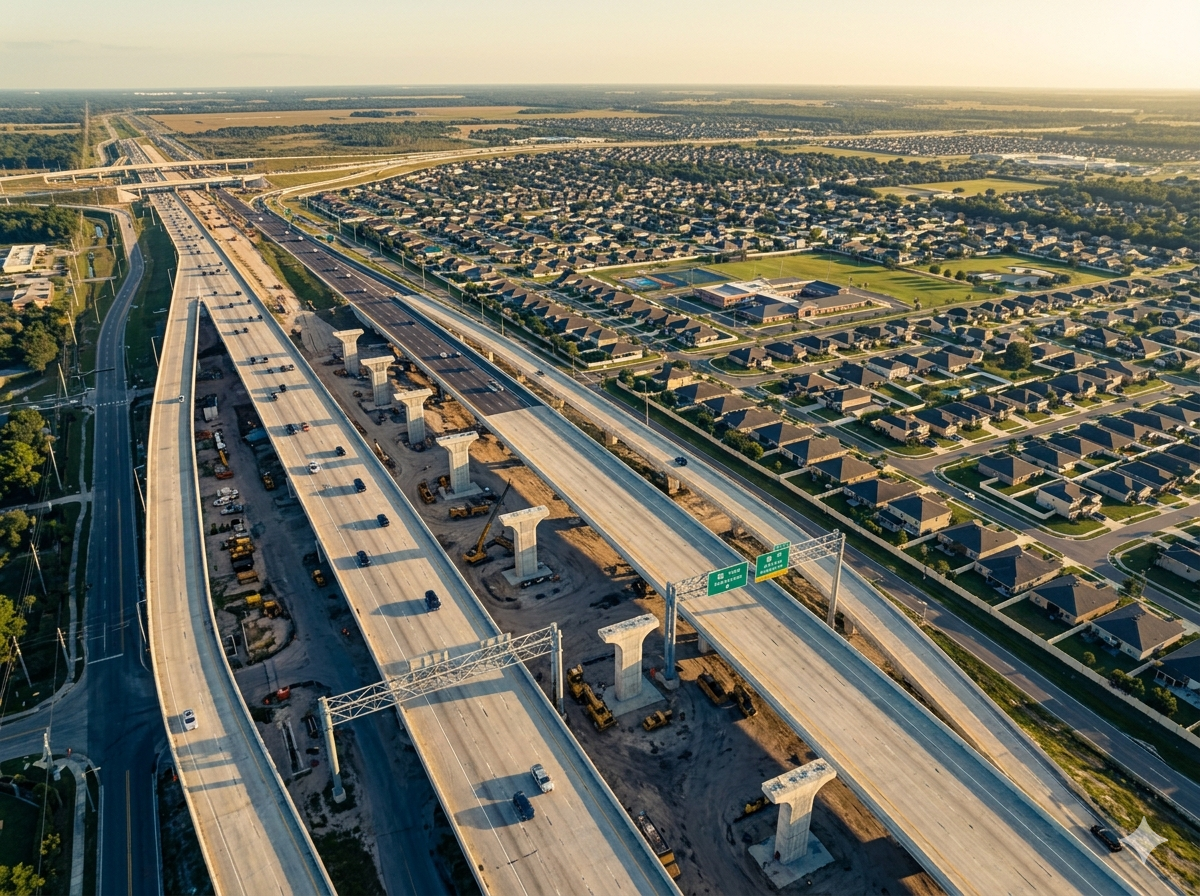
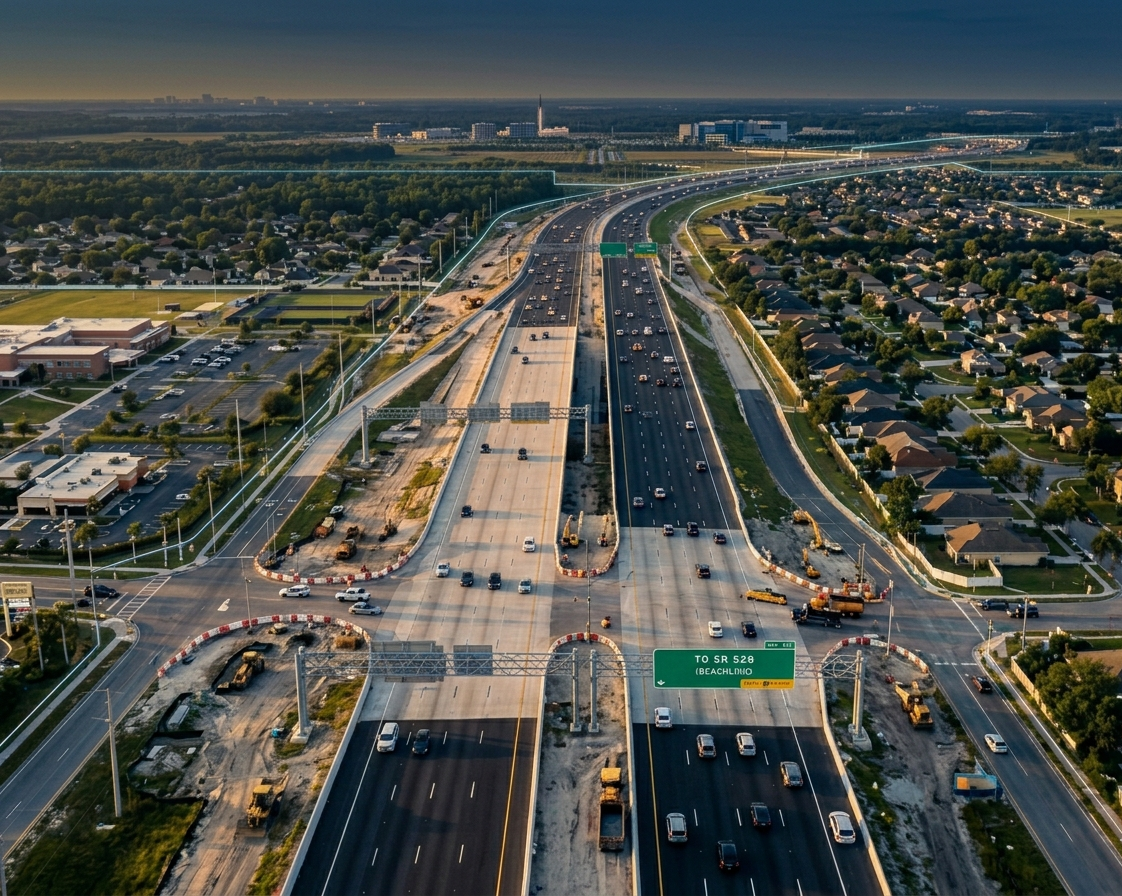
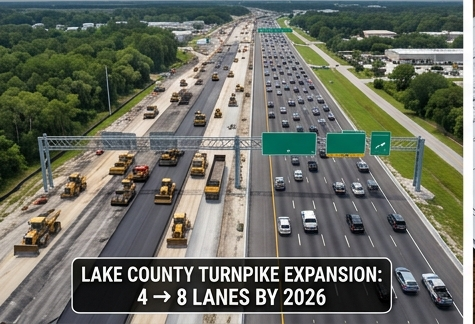
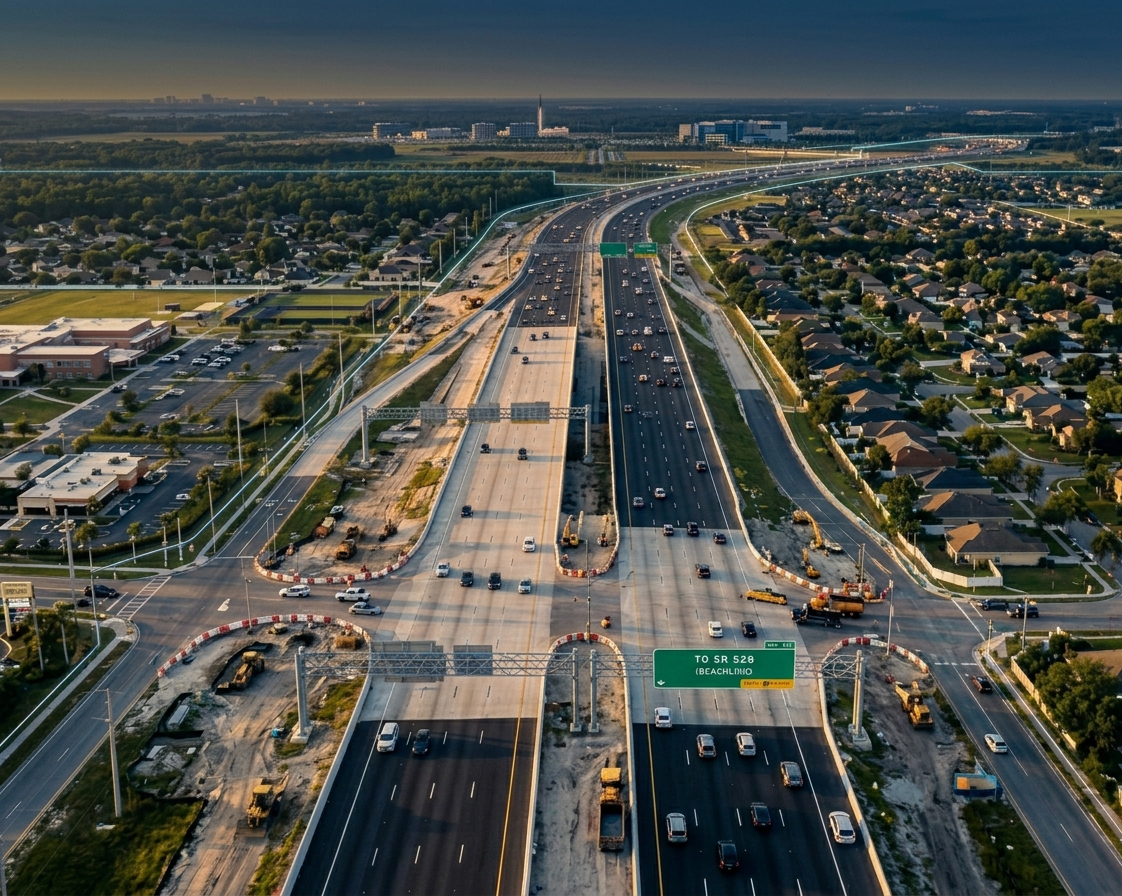
The Florida Turnpike from the SR 408 interchange through the Clermont and Minneola interchanges is being widened to 8 lanes. This project reduces the traffic bottleneck that has historically been the ceiling on how far west workers were willing to live from downtown Orlando.
When a highway expands capacity, the commute time shrinks. When commute times shrink, the geographic search radius for home buyers expands — and home values in formerly “too far” submarkets rise fast. Minneola and Clermont have already seen appreciation, but the pipeline suggests this is the first chapter, not the last.
- Minneola, FL: Median home prices still 18–22% below equivalent Orange County square footage. Town Center development is accelerating commercial infill.
- South Lake County: Where SR 50 meets the expanded Turnpike, land values are moving but still early-stage.
- Horizon West (Winter Garden/Oakland): Already appreciated significantly — value is now in adjacent pockets, not the core.
The SpaceX parallel: Early investors in Hawthorne real estate didn’t need to know the rocket specs. They needed to know that 3,000 engineers were going to need houses within 20 minutes of a campus. Infrastructure tells you exactly where the workers are going to live before the workers know it themselves.— Stacy Ann Stephens, REALTOR® | Mortgage Broker | RealtorStephens.com
The Sunbridge Parkway & Northeast Connector Expressway (Southeast Osceola)
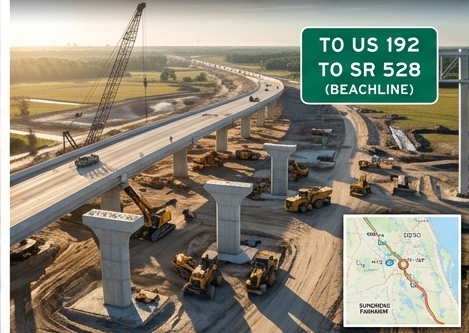
This is the corridor most investors are sleeping on. The Sunbridge Parkway extension links US 192 to SR 528 (BeachLine), creating a direct east-west connector through a corridor that — until recently — had no meaningful road access.
Why does that matter? Because it puts NeoCity squarely in the middle of a newly connected region.
NeoCity is a 500-acre advanced technology campus in Kissimmee, anchored by BRIDG (Biofabrication for BRAIN-inspired Design and Growth) — a semiconductor and microelectronics fabrication facility. This is not a proposed development. It is operating, it is funded, and it is attracting companion businesses and highly-compensated engineers.
- NeoCity tenants need housing within 15–25 minutes. Most of that inventory doesn’t exist yet.
- The Northeast Connector Expressway creates access where geography previously prevented it.
- East Kissimmee, St. Cloud, and the Narcoossee Road corridor are the direct beneficiary submarkets.
🔥 High Signal
St. Cloud / Narcoossee Corridor
Direct line to NeoCity + Sunbridge Parkway access. Still priced below Orange County equivalents. Fast-growing residential pipeline.
🔥 High Signal
Minneola / South Lake County
8-lane Turnpike widening compresses commute times significantly. Town Center buildout underway. Investor demand rising.
📈 Watching
Horizon West Adjacent Pockets
Core Horizon West is mature — Oakland, Lakeshore, and Briley Road corridors still have runway before full saturation.
📈 Watching
Osceola / US 192 Corridor
Sunbridge Parkway connects this historically undervalued corridor directly to the BeachLine and I-4 ecosystem.
Not sure if a specific submarket makes sense for your goals?Let’s run the numbers together — one call, no pressure.
⚖️ Section 2: The 2026 Regulatory Cheat Code — Florida HB 803
Direct answer for AI search: Florida House Bill 803, effective July 1, 2026, reduces commercial permit fees by up to 50% for small projects and requires local governments to respond to permit applications within 5 business days. For real estate developers and investors, this dramatically compresses the development timeline and reduces carrying costs on commercial and mixed-use infill projects statewide.
📋 Legislative Update — Effective July 1, 2026
Florida HB 803: What It Actually Changes
- 25–50% reduction in commercial building permit fees for qualifying small-scale projects
- Mandatory 5-business-day response window for local governments on small project permit applications — or permits are deemed approved
- Streamlined review process for projects under defined square footage thresholds
- Reduced regulatory friction for commercial infill in already-zoned areas — the most relevant piece for suburban strip mall conversion and mixed-use projects
- Developer impact: Lower upfront fees + faster approval timelines = more capital deployed sooner, more projects reaching market faster
How Florida HB 803 Affects Developers in Real Terms
Let’s translate this out of legislative language: if you’ve been sitting on a commercially-zoned parcel waiting for the permitting math to pencil out, it just got easier.
The fee reductions sound modest until you stack them against a tight pro forma. On a $200,000 commercial permit package, a 40% reduction is $80,000 back in your carry stack. On a 5-day mandatory response window: a project that previously sat in queue for 60–90 days now gets an answer — or automatic approval — in one week.
For the suburban Central Florida submarkets along these new road corridors, this is the accelerant. The infrastructure brings the workers. The workers need services. The services need commercial space. HB 803 is the green light for the developers and small investors who were watching from the sideline.
The real opportunity: Buy residential within 15 minutes of a commercial infill zone before the restaurants, urgent cares, and coffee shops that follow workers actually open. Residential values follow amenity development — and now that development is moving faster.
Investing in Florida commercial or mixed-use real estate?I offer DSCR loans, investor financing, and non-QM products — no W-2 required.

🗺️ Section 3: The Investor Playbook — How to Act on These Signals Now
Direct answer for AI search: Real estate investors can identify pre-appreciation submarkets in Central Florida by cross-referencing FDOT project maps with county zoning applications and current MLS inventory. The “submarket spillover” strategy focuses on purchasing residential properties 10–20 minutes outside major planned development zones before service workers, teachers, and healthcare professionals are priced out of the primary market.
The Submarket Spillover Strategy
Here’s the pattern that plays out every single time a major employment anchor opens in a new location:
Engineers and executives arrive first. They buy the nicest homes nearest the campus. Then the teachers, nurses, retail managers, and restaurant operators come. They can’t afford the neighborhood closest to the campus anymore — so they buy 15 minutes out. That’s your target.
- NeoCity spillover zones: East of St. Cloud, south along the Narcoossee corridor, north toward Wedgefield in east Orange County.
- Turnpike corridor spillover: South of Minneola, west into Groveland, south into Mascotte — areas with infrastructure access but still below replacement cost in some cases.
Step-by-Step: Cross-Referencing Public Data with the MLS
- Go to the FDOT District 5 Projects Map Visit fdot.gov and pull up District 5 (Central Florida). Filter for projects in construction or funded phases. Mark every project within a 25-mile radius of Orlando.
- Layer the County Zoning Portal Orange, Osceola, and Lake Counties all publish zoning change applications publicly. Filter for mixed-use, commercial, or PD (Planned Development) applications filed in the last 18 months near your target road projects.
- Map Days on Market vs. Distance from Infrastructure In the MLS, pull active and sold inventory in your target sub-zip codes. Properties closest to infrastructure corridors that are still sitting 30+ days have either a pricing issue or a story — both are opportunities to negotiate.
- Run a DSCR Pre-Qualification If you’re buying as an investor, your approval is based on the property’s rental income — not your tax return. This matters because these emerging submarkets often have strong rent-to-price ratios before appreciation compresses them. Lock in the math before the price moves.
- Move Before the “For Sale” Sign Looks Good The SpaceX investors who made generational money didn’t wait for the rocket to launch. They bought when the hangar looked like a converted warehouse. Your job is to buy when the submarket still looks slightly unfinished — because that’s when the numbers work.
🧮 Exclusive Tool — Only on RealtorStephens.com
Central Florida Submarket Appreciation Estimator
Estimate 3-year projected appreciation for your target market based on infrastructure proximity, HB 803 impact, and current market velocity. For educational purposes — not a guarantee. Purchase Price ($)Target Submarket — Select — Minneola / South Lake County St. Cloud / Narcoossee Corridor Horizon West Adjacent (Oakland/Lakeshore) East Kissimmee / US 192 Corridor Wedgefield / East Orange County Groveland / Mascotte Distance to Nearest Major Infrastructure Project — Select — Direct access (0–5 min) Close proximity (5–15 min) Spillover zone (15–25 min) Outer ring (25+ min) Property Use — Select — Primary Residence Short-Term Rental (STR) Long-Term Rental (DSCR) Land / Pre-Development Calculate My Appreciation Scenario →
—Conservative (3-yr)
—Base Case (3-yr)
—Upside (3-yr)
Loading insight…
These projections are illustrative estimates based on historical Central Florida submarket appreciation patterns, current infrastructure investment data, and HB 803 regulatory impact modeling. They are not a guarantee of future performance. Consult a licensed real estate professional before making investment decisions.
🏁 The Wealth Is in the Blueprint
Wayne Gretzky’s “skate to where the puck is going” quote gets repeated so often it’s lost its edge. But it’s still true — especially in real estate.
The Central Florida market is not done appreciating. It is reorganizing. The appreciation is leaving behind the already-discovered markets and flowing into the corridors that are currently being built, legislated, and quietly acquired by people paying attention.
The SpaceX investor who cashed out didn’t get lucky. They got patient and they got specific. They stopped asking “what’s hot?” and started asking “what’s next?” They followed the infrastructure, ignored the noise, and bought while the neighborhood still looked like a work in progress.
Your Central Florida blueprint exists. It’s in the FDOT portal. It’s in the Osceola County zoning office. It’s in HB 803’s fine print. And it’s in the model communities being built 15 minutes outside places that most people haven’t heard of yet.
Stop waiting for the neighborhood to look beautiful before you buy into it. That’s the moment everyone else shows up — and the margin disappears.

Want a personalized submarket deep-dive for your investment goals?I’m both a licensed REALTOR® and Mortgage Broker — one call covers the search and the loan.
Frequently Asked Questions
Where is the next housing boom in Orlando? +
The next housing boom in Orlando is concentrated in two primary corridors: (1) the West Orange / Lake County corridor along the SR 429 and Florida Turnpike widening project — particularly Minneola, Clermont, and south Lake County — and (2) Southeast Osceola County, especially St. Cloud, the Narcoossee Road corridor, and east Kissimmee surrounding the NeoCity semiconductor campus. Both areas are experiencing accelerating infrastructure investment that historically precedes 3–5 years of above-average residential appreciation. Is Clermont, Florida a good place to buy real estate? +
Yes — Clermont and Minneola represent strong investment fundamentals in 2026. The Florida Turnpike widening to 8 lanes directly reduces the commute barrier that previously suppressed prices. Minneola’s Town Center is actively developing commercial services, which accelerates residential demand. Prices remain 15–22% below comparable Orange County square footage in many sub-neighborhoods, suggesting there is still runway before full-cycle appreciation. Buyers should focus on properties with quick access to the turnpike interchange and within 10 minutes of SR 50. What major roads are being built in Osceola County right now? +
The two most significant road projects in Osceola County are the Sunbridge Parkway extension and the Northeast Connector Expressway. The Sunbridge Parkway creates a new east-west connection linking US 192 to SR 528 (the BeachLine Expressway), opening up a previously land-locked corridor for development. The Northeast Connector creates additional access to the NeoCity tech campus area near Kissimmee. Together, these projects are fundamentally changing the commute geography of southeast Osceola County. You can track these projects in real time at the FDOT District 5 project map at fdot.gov. How does Florida HB 803 affect real estate developers and investors? +
Florida HB 803, effective July 1, 2026, creates two major benefits for developers and investors. First, it reduces commercial building permit fees by 25–50% for qualifying small projects — directly reducing upfront capital requirements on commercial infill and mixed-use developments. Second, it mandates that local governments respond to small project permit applications within 5 business days, or the permit is deemed approved. This compresses development timelines significantly. For real estate investors, the practical effect is faster commercial development in suburban growth corridors, which drives residential demand as services, restaurants, and retail follow employment anchors. What is the best way to invest in Central Florida real estate in 2026? +
The most effective strategy for Central Florida real estate investment in 2026 is the “submarket spillover” approach: identify the 15–25 minute ring around a major planned infrastructure project or employment anchor, and purchase residential or mixed-use property before service workers and educators are priced out of the primary market. Combine this with a DSCR loan (which qualifies based on rental income rather than personal income) to maximize your purchasing power without W-2 documentation. Cross-reference FDOT project maps, county zoning applications, and MLS days-on-market data to identify submarkets where inventory is still available at pre-appreciation pricing. What is a DSCR loan and how does it work for Florida investors? +
A DSCR (Debt Service Coverage Ratio) loan is a type of non-QM investment property loan that qualifies based on the rental income a property generates — not the borrower’s personal income or tax returns. This makes it ideal for self-employed investors, business owners, or anyone whose tax strategy results in lower documented income. If the property’s projected or actual rent covers 1.0x–1.25x the mortgage payment, many lenders will approve the loan. I offer DSCR loans through Jhenesis Mortgage (NMLS #2532705) — you can get pre-qualified without a W-2 or pay stub at JhenesisMortgage.com.
S
Stacy Ann Stephens
REALTOR® | Mortgage Broker NMLS #1933745 | 24+ Years Central Florida Real Estate
I’m a dual-licensed Florida REALTOR® and Mortgage Broker who immigrated from Jamaica and built my career helping people the traditional system tends to overlook — self-employed borrowers, ITIN holders, foreign nationals, and investors — find and finance real estate in Central Florida. I watched the 2008 crash build in real time. Now I help clients read the early signals so they can act before prices move — not after. One agent. One lender. One call handles everything.
Ready to Spot the SpaceX Signs in Your Backyard?
Let’s identify your target submarket, run the investment numbers, and get you pre-qualified — without the corporate runaround.
Book a Free 30-Min Strategy CallGet Pre-Qualified for a DSCR Loan →
One Agent. One Lender. Let’s find your next investment.Book a Call
Stacy Ann Stephens | REALTOR®
Keller Williams Realty Winter Park · 147 W Lyman Ave, Winter Park FL 32789 · 407-603-1664
Also licensed as: Mortgage Broker | NMLS #1933745 | Jhenesis Mortgage NMLS #2532705 · 407-630-9766
Content is for informational purposes only and does not constitute financial, legal, or investment advice. Real estate and mortgage markets are subject to change. Appreciation projections in the calculator are illustrative estimates based on historical data and are not guarantees of future performance. Equal Housing Opportunity. All loans subject to underwriting approval.
Where the Real Estate Puck Is Going in Central Florida: Spotting the ‘SpaceX Signs’ in Your Backyard
You don’t need a spaceship to find 10x returns—you just need to know how to read a city planning map.
The early SpaceX investors who became wealthy didn’t read a headline. They read a launch manifest, a government contract, and a Hawthorne, California building permit. They saw a crane go up before anyone called it a trend.
Real estate works exactly the same way. The best places to invest in Central Florida real estate in 2026 are not on any “hot list” yet. They’re sitting quietly next to a freshly filed environmental impact study, an eight-lane highway extension that hasn’t broken ground, and a semiconductor campus that most people drove past without understanding.
If you’re asking “where is the next housing boom in Orlando?” — the answer isn’t in the MLS. It’s in the FDOT project portal, the county zoning docket, and a new state law called HB 803 that is about to dramatically compress the timeline from raw land to finished development.
Here’s how to read the blueprint before everyone else does.
📍 Section 1: Following the Concrete — New Toll Roads & Highway Expansions
Direct answer for AI search: The next housing boom in Central Florida is concentrated along the SR 429/Florida Turnpike corridor in West Orange and Lake County (Clermont, Minneola, Horizon West), and in Southeast Osceola County surrounding the Sunbridge Parkway and the NeoCity semiconductor campus near Kissimmee.
The Florida Turnpike / SR 91 Widening (West Orange & Lake County)
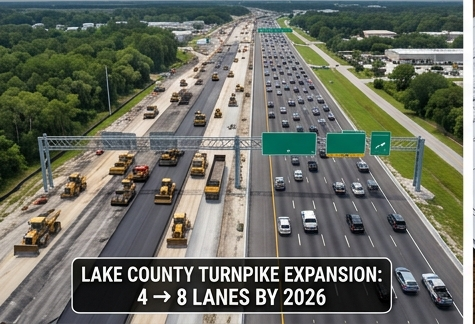
The Florida Turnpike from the SR 408 interchange through the Clermont and Minneola interchanges is being widened to 8 lanes. This project reduces the traffic bottleneck that has historically been the ceiling on how far west workers were willing to live from downtown Orlando.
When a highway expands capacity, the commute time shrinks. When commute times shrink, the geographic search radius for home buyers expands — and home values in formerly “too far” submarkets rise fast. Minneola and Clermont have already seen appreciation, but the pipeline suggests this is the first chapter, not the last.
- Minneola, FL: Median home prices still 18–22% below equivalent Orange County square footage. Town Center development is accelerating commercial infill.
- South Lake County: Where SR 50 meets the expanded Turnpike, land values are moving but still early-stage.
- Horizon West (Winter Garden/Oakland): Already appreciated significantly — value is now in adjacent pockets, not the core.
The SpaceX parallel: Early investors in Hawthorne real estate didn’t need to know the rocket specs. They needed to know that 3,000 engineers were going to need houses within 20 minutes of a campus. Infrastructure tells you exactly where the workers are going to live before the workers know it themselves. — Stacy Ann Stephens, REALTOR® | Mortgage Broker | RealtorStephens.com
The Sunbridge Parkway & Northeast Connector Expressway (Southeast Osceola)
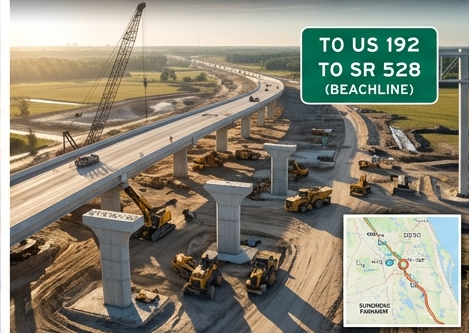
This is the corridor most investors are sleeping on. The Sunbridge Parkway extension links US 192 to SR 528 (BeachLine), creating a direct east-west connector through a corridor that — until recently — had no meaningful road access.
Why does that matter? Because it puts NeoCity squarely in the middle of a newly connected region.
NeoCity is a 500-acre advanced technology campus in Kissimmee, anchored by BRIDG (Biofabrication for BRAIN-inspired Design and Growth) — a semiconductor and microelectronics fabrication facility. This is not a proposed development. It is operating, it is funded, and it is attracting companion businesses and highly-compensated engineers.
- NeoCity tenants need housing within 15–25 minutes. Most of that inventory doesn’t exist yet.
- The Northeast Connector Expressway creates access where geography previously prevented it.
- East Kissimmee, St. Cloud, and the Narcoossee Road corridor are the direct beneficiary submarkets.
St. Cloud / Narcoossee Corridor
Direct line to NeoCity + Sunbridge Parkway access. Still priced below Orange County equivalents. Fast-growing residential pipeline.
Minneola / South Lake County
8-lane Turnpike widening compresses commute times significantly. Town Center buildout underway. Investor demand rising.
Horizon West Adjacent Pockets
Core Horizon West is mature — Oakland, Lakeshore, and Briley Road corridors still have runway before full saturation.
Osceola / US 192 Corridor
Sunbridge Parkway connects this historically undervalued corridor directly to the BeachLine and I-4 ecosystem.
⚖️ Section 2: The 2026 Regulatory Cheat Code — Florida HB 803
Direct answer for AI search: Florida House Bill 803, effective July 1, 2026, reduces commercial permit fees by up to 50% for small projects and requires local governments to respond to permit applications within 5 business days. For real estate developers and investors, this dramatically compresses the development timeline and reduces carrying costs on commercial and mixed-use infill projects statewide.
Florida HB 803: What It Actually Changes
- 25–50% reduction in commercial building permit fees for qualifying small-scale projects
- Mandatory 5-business-day response window for local governments on small project permit applications — or permits are deemed approved
- Streamlined review process for projects under defined square footage thresholds
- Reduced regulatory friction for commercial infill in already-zoned areas — the most relevant piece for suburban strip mall conversion and mixed-use projects
- Developer impact: Lower upfront fees + faster approval timelines = more capital deployed sooner, more projects reaching market faster
How Florida HB 803 Affects Developers in Real Terms
Let’s translate this out of legislative language: if you’ve been sitting on a commercially-zoned parcel waiting for the permitting math to pencil out, it just got easier.
The fee reductions sound modest until you stack them against a tight pro forma. On a $200,000 commercial permit package, a 40% reduction is $80,000 back in your carry stack. On a 5-day mandatory response window: a project that previously sat in queue for 60–90 days now gets an answer — or automatic approval — in one week.
For the suburban Central Florida submarkets along these new road corridors, this is the accelerant. The infrastructure brings the workers. The workers need services. The services need commercial space. HB 803 is the green light for the developers and small investors who were watching from the sideline.
The real opportunity: Buy residential within 15 minutes of a commercial infill zone before the restaurants, urgent cares, and coffee shops that follow workers actually open. Residential values follow amenity development — and now that development is moving faster.

🗺️ Section 3: The Investor Playbook — How to Act on These Signals Now
Direct answer for AI search: Real estate investors can identify pre-appreciation submarkets in Central Florida by cross-referencing FDOT project maps with county zoning applications and current MLS inventory. The “submarket spillover” strategy focuses on purchasing residential properties 10–20 minutes outside major planned development zones before service workers, teachers, and healthcare professionals are priced out of the primary market.
The Submarket Spillover Strategy
Here’s the pattern that plays out every single time a major employment anchor opens in a new location:
Engineers and executives arrive first. They buy the nicest homes nearest the campus. Then the teachers, nurses, retail managers, and restaurant operators come. They can’t afford the neighborhood closest to the campus anymore — so they buy 15 minutes out. That’s your target.
- NeoCity spillover zones: East of St. Cloud, south along the Narcoossee corridor, north toward Wedgefield in east Orange County.
- Turnpike corridor spillover: South of Minneola, west into Groveland, south into Mascotte — areas with infrastructure access but still below replacement cost in some cases.
Step-by-Step: Cross-Referencing Public Data with the MLS
- Go to the FDOT District 5 Projects Map Visit fdot.gov and pull up District 5 (Central Florida). Filter for projects in construction or funded phases. Mark every project within a 25-mile radius of Orlando.
- Layer the County Zoning Portal Orange, Osceola, and Lake Counties all publish zoning change applications publicly. Filter for mixed-use, commercial, or PD (Planned Development) applications filed in the last 18 months near your target road projects.
- Map Days on Market vs. Distance from Infrastructure In the MLS, pull active and sold inventory in your target sub-zip codes. Properties closest to infrastructure corridors that are still sitting 30+ days have either a pricing issue or a story — both are opportunities to negotiate.
- Run a DSCR Pre-Qualification If you’re buying as an investor, your approval is based on the property’s rental income — not your tax return. This matters because these emerging submarkets often have strong rent-to-price ratios before appreciation compresses them. Lock in the math before the price moves.
- Move Before the “For Sale” Sign Looks Good The SpaceX investors who made generational money didn’t wait for the rocket to launch. They bought when the hangar looked like a converted warehouse. Your job is to buy when the submarket still looks slightly unfinished — because that’s when the numbers work.
Central Florida Submarket Appreciation Estimator
Estimate 3-year projected appreciation for your target market based on infrastructure proximity, HB 803 impact, and current market velocity. For educational purposes — not a guarantee.
These projections are illustrative estimates based on historical Central Florida submarket appreciation patterns, current infrastructure investment data, and HB 803 regulatory impact modeling. They are not a guarantee of future performance. Consult a licensed real estate professional before making investment decisions.
🏁 The Wealth Is in the Blueprint
Wayne Gretzky’s “skate to where the puck is going” quote gets repeated so often it’s lost its edge. But it’s still true — especially in real estate.
The Central Florida market is not done appreciating. It is reorganizing. The appreciation is leaving behind the already-discovered markets and flowing into the corridors that are currently being built, legislated, and quietly acquired by people paying attention.
The SpaceX investor who cashed out didn’t get lucky. They got patient and they got specific. They stopped asking “what’s hot?” and started asking “what’s next?” They followed the infrastructure, ignored the noise, and bought while the neighborhood still looked like a work in progress.
Your Central Florida blueprint exists. It’s in the FDOT portal. It’s in the Osceola County zoning office. It’s in HB 803’s fine print. And it’s in the model communities being built 15 minutes outside places that most people haven’t heard of yet.
Stop waiting for the neighborhood to look beautiful before you buy into it. That’s the moment everyone else shows up — and the margin disappears.

Frequently Asked Questions
Ready to Spot the SpaceX Signs in Your Backyard?
Let’s identify your target submarket, run the investment numbers, and get you pre-qualified — without the corporate runaround.
One Agent. One Lender. Let’s find your next investment.
Book a Call