
Central Florida Real Estate Guide
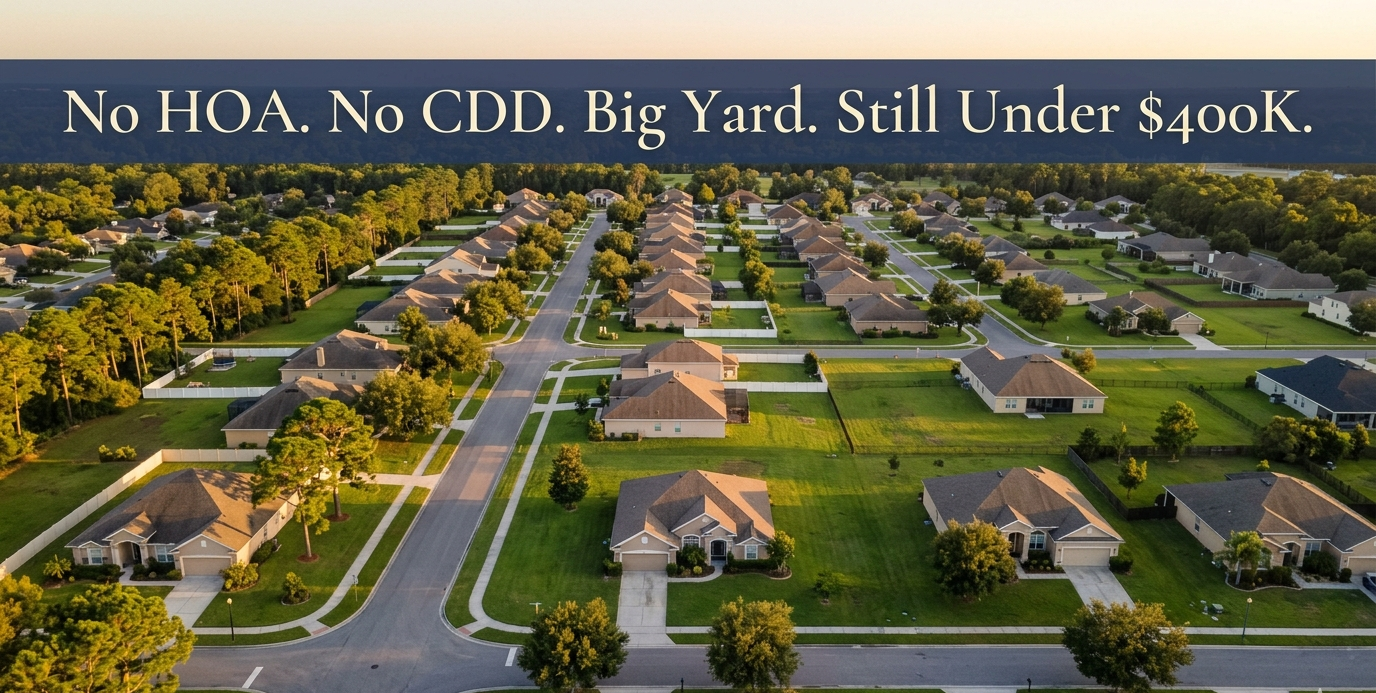
No HOA. No CDD. Big Yard. Here’s Where You Can Still Find This Near Orlando — Under $400K
The hidden suburbs 20–35 minutes from Orlando where freedom, space, and real affordability still exist — and where savvy buyers are quietly winning.
Let me tell you what’s really happening in the Central Florida market right now. Buyers are coming to me with pre-approvals in hand, ready to buy — and then they start touring communities and doing the math. A $360,000 home. HOA: $285/month. CDD: $175/month. Suddenly you’re looking at an extra $5,520 per year on top of your mortgage, taxes, and insurance. That’s not a hidden cost. That’s a whole second bill.
The good news? You don’t have to accept it. If you’re willing to look just 20–35 minutes outside the tourist corridor, there are pockets of Central Florida where big lots, no monthly restrictions, and genuine affordability still coexist. I’ve helped clients find them — and today I’m going to show you exactly where to look.
What Is the Real Cost of an HOA or CDD — and Why Does It Matter So Much Right Now?
An HOA (Homeowners Association) fee pays for shared community amenities and enforces neighborhood rules — landscaping standards, exterior paint colors, parking policies. A CDD (Community Development District) fee is different and often misunderstood: it’s a special assessment built into your property tax bill that repays the developer’s infrastructure bonds. Roads, utilities, the community pool — the developer built them, and you’re paying them back, often for 20–30 years.
Here’s what buyers often don’t realize: CDDs don’t disappear when you sell. They transfer to the next owner. And unlike HOA fees, you can’t opt out or vote them away. They’re on your tax bill, period.
In the current market where interest rates are keeping monthly payments tight, these fees can be the difference between qualifying comfortably and being stretched to the limit. I’ve seen buyers’ DTI (debt-to-income ratio) pushed over lender limits specifically because of HOA and CDD obligations. That’s a real problem — and it has a real solution.
The Pockets Where No-HOA, No-CDD Homes Still Exist Near Orlando
These aren’t secret. But they’re not where the big builder ads are pointing you. Here’s what I’m seeing on the ground:
Apopka (North Orange County)
Apopka is one of the last remaining areas in Orange County where you can still find independently platted subdivisions — established neighborhoods from the 1980s and 1990s that predate the master-planned community wave. Lots run 0.25–0.4 acres, no HOA, no CDD. Prices are moving but you can still find homes in the $320K–$395K range. The SR-429 extension has made commutes to Winter Park and downtown Orlando genuinely reasonable — 25–30 minutes off-peak.
Ocoee (West Orange County)
Ocoee sits just west of Winter Garden on the 408 corridor. There are still pockets of single-family homes — particularly off Maguire Road and in older subdivisions near Lake Apopka — that carry no HOA restrictions. Lot sizes tend to be generous. The proximity to downtown Orlando (about 20 minutes) makes this a sleeper hit for buyers who need access but want breathing room.
Polk County — Lakeland, Auburndale, and Haines City
Cross the Orange/Polk county line and the math changes significantly. Lakeland in particular has whole quadrants of the city — particularly northeast and southeast — where established neighborhoods have zero HOA or CDD. You’re looking at quarter-acre to half-acre lots, under $350K in many cases, and a real small-city infrastructure: a functioning downtown, good schools, and I-4 access heading both east (toward Orlando) and west (toward Tampa). Auburndale and Haines City follow a similar pattern.
| Area | Avg Price Range | Lot Size | Commute to Orlando | HOA/CDD |
|---|---|---|---|---|
| Apopka | $320K–$395K | 0.25–0.40 ac | 25–30 min | None (selected subdivisions) |
| Ocoee | $315K–$390K | 0.20–0.35 ac | 20–25 min | None (select areas) |
| Lakeland | $270K–$360K | 0.25–0.50 ac | 45–55 min | None (established neighborhoods) |
| Auburndale | $265K–$345K | 0.30–0.60 ac | 50–60 min | None |
| Haines City | $255K–$330K | 0.25–0.45 ac | 55–65 min | None |
What You Actually Get vs. a Gated Community (An Honest Comparison)
I’ll be straight with you: master-planned communities aren’t bad. The amenities can be beautiful, the maintenance standards are consistent, and some buyers genuinely love the lifestyle. But it’s not for everyone — and the fees aren’t always worth what you’re getting.
Here’s the honest trade-off:
- No HOA/No CDD homes: More land, more freedom, lower total monthly cost, ability to add a guest house or park your boat/RV, no restrictions on fence height or exterior paint color.
- HOA/CDD communities: Manicured common areas, community pool, possibly a gym or clubhouse, neighborhood uniformity, potentially stronger appreciation in some markets.
For a first-time buyer trying to make the mortgage work, or a buyer who plans to have a multigenerational setup, or someone who simply wants to park their truck in their own driveway without a violation notice — the no-HOA option often wins on both lifestyle and finances.
🏡 HOA True Cost Calculator
See how much HOA + CDD fees add to your total purchase cost over time — and what that money could be doing instead.
How to Search for No-HOA Homes the Right Way
Here’s where buyers trip up: Zillow and most consumer portals don’t let you filter by HOA status reliably. You can select “No HOA” but the data is self-reported by sellers, and it’s often incomplete or wrong. I’ve had clients fall in love with a “No HOA” listing that turned out to have a voluntary neighborhood association fee that wasn’t disclosed until inspection.
The cleaner approach is to work with an agent (like me) who has full MLS access and knows which specific subdivisions are restriction-free. I can pull plat records, tax records, and deed restrictions to verify before you spend your weekend touring a home that doesn’t actually meet your criteria.