
The Real Reason Florida Home Sales Fall Through in 2026 — And It’s Not the Mortgage

Florida Home Insurance Pre-Listing Guide 2026: What Sellers Must Know | RealtorStephens.com
🏠 Thinking about listing your Florida home? One call can prevent a deal-killing surprise.  407-603-1664
Pre-Listing Strategy · Florida Sellers · 2026

The Real Reason Florida Home Sales Fall Through in 2026 — And It’s Not the Mortgage

In today’s Central Florida market, the biggest deal-killer isn’t your buyer’s credit score or debt-to-income ratio. It’s whether their insurance company will write a policy on your home. Here’s what every seller needs to know before they list.

By Stacy Ann Stephens, REALTOR® · Keller Williams Winter Park · Updated June 2026

📞 Free Pre-Listing Consultation Book Strategy Call
S
Stacy Ann Stephens | REALTOR®
Keller Williams Realty Winter Park · 147 W Lyman Ave, Winter Park FL 32789 · 407-603-1664 · License #BK3393979

Here’s a scenario I’ve seen play out too many times. A seller lists their home. They get an offer within a few weeks — good price, qualified buyer, pre-approved financing. They go under contract. Everyone exhales. And then, three weeks before closing, the insurance company declines to write a policy. Or they’ll write one, but only after the roof is replaced. The buyer can’t close without insurance. The seller doesn’t want to replace the roof. The deal dies.

This scenario is not a fringe case in Florida in 2026. It is a regular occurrence in the Central Florida market. And it is almost entirely preventable — if sellers know what to look for and address it before listing.

The Florida homeowners insurance market has undergone a dramatic restructuring since 2022. Multiple major carriers have exited the state entirely. Citizens Property Insurance (the state insurer of last resort) has implemented stricter underwriting. New carriers have entered but with tighter standards. The result: getting a home insured in Florida in 2026 requires your home to meet specific condition standards — and buyers’ lenders won’t close without confirmed insurance in place.

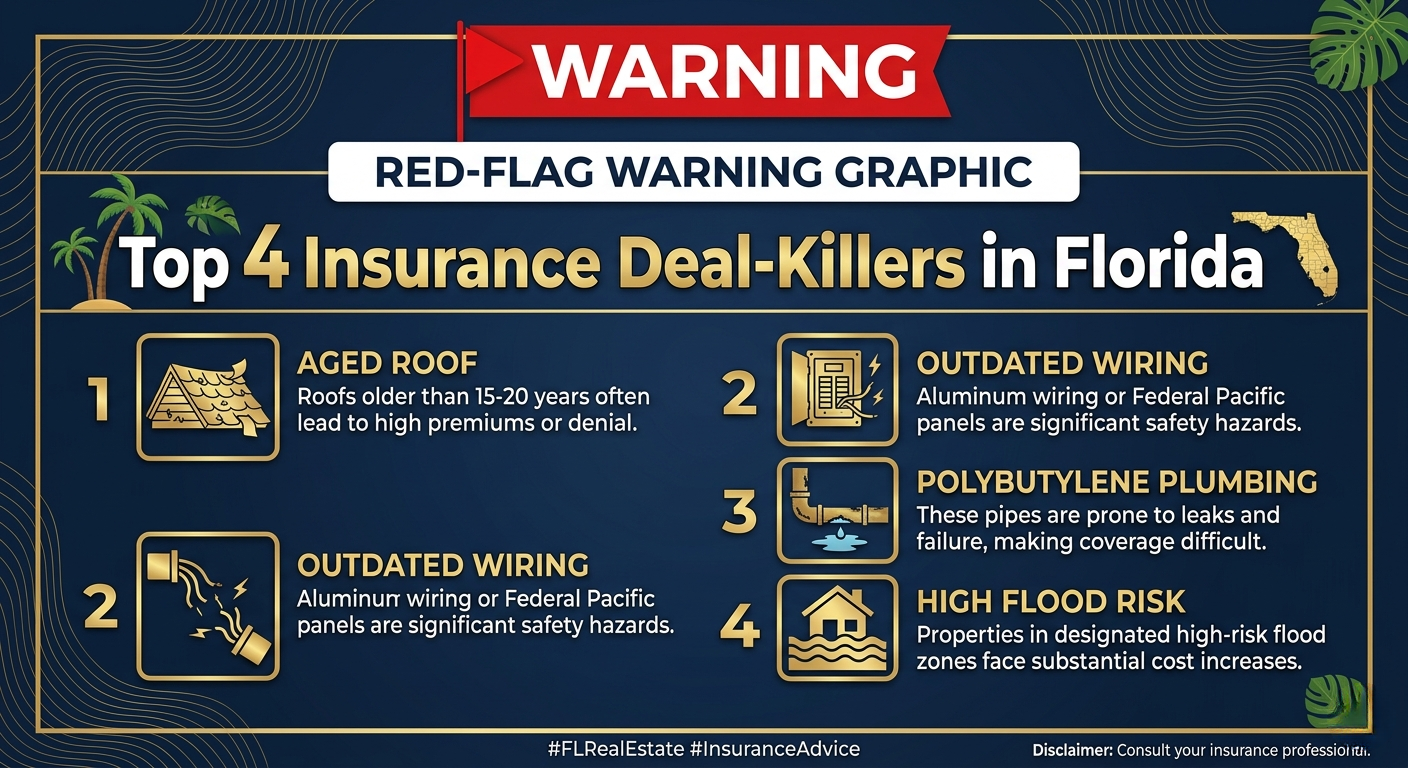
What Makes a Home Uninsurable in Florida?

Florida insurance carriers evaluate risk based on a set of property characteristics. These are the conditions that most commonly trigger policy denials or prohibitively high premiums:

🚫 Roof Age: 15+ Years (Shingle)
Many Florida carriers will not write a policy on a home with a shingle roof older than 15 years. Some draw the line at 10. Metal roofs are treated more favorably.
🚫 Federal Pacific or Zinsco Panels
These older electrical panels are considered high fire risk. Most insurers refuse to write policies on homes with these specific panel brands.
🚫 Polybutylene Plumbing
This gray plastic pipe used in Florida homes from the 1970s–1990s has a high failure rate and is rejected by most insurers and flagged by buyers’ lenders.
🚫 Galvanized Steel Plumbing
Found in older Florida homes, galvanized pipes corrode from the inside and are a common source of water damage claims. Insurers price this heavily or decline to cover.
🚫 No Wind Mitigation Features
Homes without hurricane straps, secondary water resistance, or impact-rated openings receive significantly higher wind premiums — sometimes affecting buyer affordability.
🚫 Active Roof Damage or Leaks
Any visible evidence of roof damage, missing tiles, or active leaks will result in immediate policy denial until repairs are complete and documented.
Key point: A buyer’s lender requires insurance to be bound before closing. If the home is uninsurable as-is, the buyer cannot get a mortgage. The deal stops — not because of credit, not because of price, but because of your roof or your panel.

Why Pre-Listing Inspections Are Now Non-Negotiable

In a market where buyers are doing their due diligence and buyers’ insurance agents are often doing a drive-by check before even writing a quote, surprises after contract kill deals. A pre-listing inspection gives you the power to know — and address — what a buyer is going to discover.

There are two specific inspections that matter most in Florida’s current market:

1. The 4-Point Inspection

The 4-point inspection evaluates four major systems: roof, electrical, plumbing, and HVAC. It’s the document Florida insurance carriers require to write a policy on any home that’s 20+ years old — which covers a significant portion of Central Florida’s housing stock.

Getting a 4-point done before you list means:

  • You know exactly what an insurer will see — no surprises
  • You can make cost-effective repairs before listing, rather than under contract deadline pressure
  • You can share it with serious buyers proactively, building confidence and reducing their inspection contingency leverage

2. The Wind Mitigation Inspection

A wind mitigation report documents hurricane-resistance features of your home — roof-to-wall connections, opening protection, roof covering, roof deck attachment, and more. A strong wind mitigation report can save a Florida homebuyer hundreds of dollars per year on their insurance premium. Sharing one proactively is a genuine selling point — it makes your home more attractive and more financeable.

📋 Florida Seller Pre-Listing Insurance & Condition Checklist

Work through this before you list. Critical items (red) can kill a deal. Important items (yellow) affect buyer affordability. Smart items (green) are competitive advantages.

Know your roof age and material — obtain documentation if over 10 years old
CRITICAL
Order a 4-Point Inspection ($75–$125) — know what the insurer will see before buyers do
CRITICAL
Identify your electrical panel brand — confirm it is NOT Federal Pacific or Zinsco
CRITICAL
Know your plumbing type — confirm it is NOT polybutylene (gray plastic) or galvanized steel
CRITICAL
Check whether your property is in a flood zone — obtain FEMA FIRM map designation
IMPORTANT
Order a Wind Mitigation Inspection ($75–$150) — a strong report is a buyer advantage
SMART
Address any visible roof damage, missing tiles, or signs of leaks before listing
CRITICAL
Get at least two insurance quotes on your home as-is — know what buyers will face
IMPORTANT
Have HVAC service records available — age and condition affect 4-point results
IMPORTANT
Obtain a CLUE Report (Comprehensive Loss Underwriting Exchange) — see your claims history as an insurer would
SMART
Prepare a digital folder of all inspection reports, permits, and system age documentation to share with buyers
SMART
0 of 11 completed

What Does Home Insurance Actually Cost in Central Florida in 2026?

This is the number that’s affecting buyer affordability — and therefore your buyer pool. Understanding what buyers are facing helps you position your home’s condition as a competitive advantage.

Property Type / Age / LocationEstimated Annual PremiumKey Factors
New construction (<5 years), inland Central FL$1,800–$3,200New roof, modern panel, impact windows
10–15 year old home, inland Central FL, good condition$2,400–$4,500Roof age matters most; wind mit helps
15–20 year old home, no wind mitigation$4,000–$7,000Significant surcharges for aging systems
20+ year old home, shingle roof, older panel$6,000–$12,000+May struggle to find coverage at all
Coastal/waterfront property, any age$8,000–$25,000+Wind/flood exposure, carrier restrictions
Pool home, standard age/condition, inland$2,800–$5,500Liability considerations add modest surcharge
Why this matters to your sale: A buyer looking at your $380,000 home who discovers insurance will cost $8,000/year (vs. the $2,500 they budgeted) is now looking at $458/month more in housing costs than they planned. That’s often enough to kill affordability — or cause them to walk away from your home in favor of a newer one.

Don’t Find Out About Your Insurance Problem at Contract

I help Central Florida sellers understand exactly what buyers and their insurance agents will find — before it becomes a negotiation crisis. Let me walk through your home’s situation before you list.

📞 Free Pre-Listing Call: 407-603-1664

Frequently Asked Questions

What makes a house uninsurable in Florida?+
Common factors that make a Florida home uninsurable or very difficult to insure include: a shingle roof older than 15 years (some carriers say 10), Federal Pacific or Zinsco electrical panels, polybutylene or galvanized plumbing, active roof damage, and certain older construction types. The 4-point inspection is the document insurers use to evaluate these systems.
Should I get a home inspection before listing in Orlando?+
Yes — particularly a 4-point inspection and a wind mitigation inspection. In 2026, insurance underwriting has become the most common deal-killer in Central Florida transactions. A pre-listing 4-point inspection costs $75 to $125 and tells you exactly what buyers’ insurers will see, so you can address issues before going under contract rather than under deadline pressure.
Can a buyer get insurance on a home with an older roof in Florida?+
It depends on the roof age, material, and condition. Many Florida carriers will not write new policies on shingle roofs older than 15 years. Some are stricter. Metal roofs are treated more favorably. If your roof is approaching or past these thresholds, you may need to replace it, offer a repair credit, or find specialized carriers who will write the policy — all of which affect your sale negotiation.
What is a 4-point inspection and why do I need one when selling in Florida?+
A 4-point inspection evaluates the four major systems of a home: roof, electrical, plumbing, and HVAC. Florida insurance carriers require this report to write policies on homes 20 or more years old. As a seller, getting one before listing tells you what buyers’ insurance companies will find and gives you the opportunity to make repairs or adjustments before going under contract.
What is a wind mitigation inspection and does it help my home sell?+
A wind mitigation inspection documents hurricane-resistance features of your home. A strong report can reduce a buyer’s annual insurance premium by hundreds of dollars per year. Sharing a favorable wind mitigation report with prospective buyers is a genuine competitive advantage — it makes your home more affordable to own and easier to finance.
How much does homeowners insurance cost in Central Florida in 2026?+
In Central Florida in 2026, homeowners insurance premiums range from approximately $1,800 to $3,200 per year for newer homes in good condition to $6,000 to $12,000 or more for older homes with aging systems and no wind mitigation. Coastal properties can run $8,000 to $25,000 annually. The specific roof age, panel type, and construction features are the primary cost drivers.

One Conversation Can Save Your Sale

Let me tell you exactly what to check, what to fix, and how to position your home’s condition as an advantage — before buyers and their insurance agents find out the hard way.

📞 407-603-1664 — Let’s Talk
S
Stacy Ann Stephens | REALTOR®
Keller Williams Realty Winter Park · 147 W Lyman Ave, Winter Park FL 32789 · 407-603-1664 · License #BK3393979
This post is for informational purposes only. Insurance availability and pricing vary by carrier, property, and market conditions. Always obtain professional insurance advice specific to your home.