
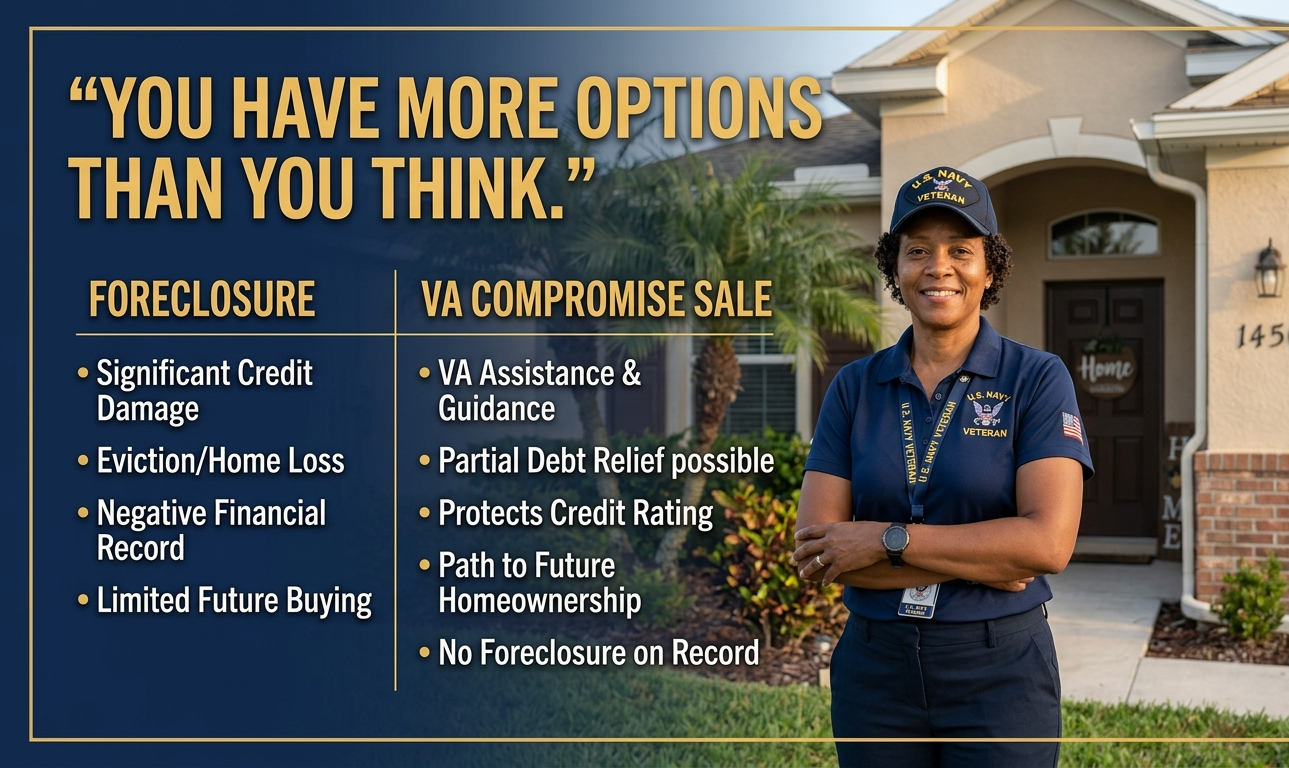
You Can Sell Your Home Even If You Owe More Than It’s Worth
The VA Compromise Sale Program gives underwater veterans a way out — no cash at closing, less credit damage than foreclosure, and a path forward. Here’s everything you need to know.
📞 Talk to Stacy Free Book a ConsultationLet me tell you something I’ve seen too many times in Central Florida. A veteran bought a home in 2021 or 2022 — maybe used their VA loan benefit, zero down, felt proud about it — and then life happened. A PCS order. A divorce. A medical situation. Job loss. And suddenly their rate is 6%, 7%, even 7.5%, the home’s value hasn’t kept pace, and they’re underwater. They owe more than the house is worth.
They can’t do an IRRRL (VA streamline refinance) because they’ve missed payments. They think they’re trapped. They think their only options are foreclosure or just… staying in a home they can’t afford and may not even be living in anymore.
I’m writing this because I want every veteran in Florida who’s in that situation to know: there is a third door. It’s called the VA Compromise Sale — and most real estate agents don’t know how to navigate it.
What Is the VA Compromise Sale Program?
The VA Compromise Sale (sometimes called a VA short sale) is a program where the Department of Veterans Affairs steps in to help you sell your home for less than you owe on your mortgage — and covers the shortfall between the sale price and your loan balance.
Think about that. You’re underwater by $30,000. You list the home, find a buyer, and the VA works with your servicer to approve the sale. The lender gets paid. You walk away. No deficiency judgment chasing you. No cash out of your pocket at closing.
How Is This Different from a Regular Short Sale?
A regular short sale is between you, your lender, and a buyer. It’s negotiated, slow, unpredictable. With a VA Compromise Sale, the VA acts as a guarantor — they’ve already promised to cover losses on your loan. That means when the VA approves the sale, they’re using that guarantee to cover the gap. The process is more structured, more predictable, and often faster than a conventional short sale.
According to specialists in Florida who work VA short sales regularly, the process follows clear guidelines that have been in place for decades — and the outcome is more consistent than most people expect.
Foreclosure vs. Short Sale vs. VA Compromise Sale
- Severe credit damage (100–150 pts)
- 7-year hit on credit report
- VA entitlement lost until VA is repaid
- May face deficiency judgment
- No control over timeline
- VA loan again: 2+ years minimum
- Moderate credit damage (75–100 pts)
- Lender negotiation required
- Unpredictable timeline (3–12 months)
- Possible deficiency judgment
- No VA backing = no structure
- VA loan again: 2 years
- Less credit damage than foreclosure
- VA covers the shortfall
- Structured, predictable process
- No cash out of pocket at closing
- No deficiency in most cases
- VA loan again: typically 2 years
Do You Qualify? The VA Compromise Sale Requirements
Not every underwater veteran will qualify for the VA Compromise Sale. There are specific conditions that must be met. Here’s what the VA and your servicer will look for:
- You must have a VA-backed loan — this program applies only to VA-guaranteed mortgages
- Proven financial hardship — job loss, medical expenses, divorce, PCS orders, income reduction. Simply being underwater isn’t enough; you need documented hardship
- Property must be your primary residence (or was your primary residence — the VA understands military families move)
- You must price and sell at current fair market value — the sale price must reflect an independent appraisal
- Minimum net proceeds — the sale must generate at least 84.05% of the appraised value (individual lenders may require higher)
- No second liens or junior mortgages in most cases — though small liens may be negotiable
- The compromise sale must cost the VA less than a foreclosure — this is evaluated by the VA during approval
- You must have an accepted purchase offer before applying for compromise sale approval
What Happens to Your VA Entitlement After a Compromise Sale?
This is the part that scares veterans the most — and it’s where I want to give you the full, honest picture.
When the VA covers the shortfall in your compromise sale, the portion of your entitlement used to guarantee that original loan does not get restored. It stays “tied up” until the VA is reimbursed in full. That means you’ll have reduced VA entitlement going forward.
What Does That Actually Mean for Your Next Home?
Here’s the thing most people miss: reduced entitlement is not zero entitlement. You can still use your VA loan benefit to buy another home. You’ll likely still have “bonus entitlement” (second-tier entitlement) available. Depending on your loan balance and the county loan limits, you may still be able to buy with zero down — or with a modest down payment to cover the gap.
For 2025–2026, the standard VA conforming loan limit is $819,000 in most Florida counties. Your VA still guarantees 25% of the loan amount. If your unrestored entitlement is $40,000, you still have substantial buying power remaining.
The key is getting your Certificate of Eligibility reviewed and your entitlement calculated by someone who knows how to run the math — which is exactly what I do as a dual-licensed agent and mortgage broker.
🧮 VA Entitlement Estimator After Compromise Sale
Estimates only. For exact figures, request your Certificate of Eligibility from the VA or work with a licensed VA loan specialist.
This is a simplified estimate. Your actual entitlement depends on your full COE, county limits, and any other active VA obligations. Call Stacy at 407-603-1664 to get the real numbers.
The VA Compromise Sale Process: Step by Step
One of the reasons this program works better than most people expect is that it’s structured. Here’s how it unfolds:
- Contact a VA Loan Technician: Before anything else, call the VA at 877-827-3702. They’ll review your loan situation, confirm your options, and potentially assign a technician to your file. This is free.
- Contact Your Loan Servicer: Let them know you’re experiencing hardship and want to explore a compromise sale. Your servicer is the company you’ve been sending payments to — not always the original lender.
- Document Your Hardship: Gather proof of your financial difficulty — pay stubs, termination letters, medical bills, military orders, divorce decree, etc. The more documented, the smoother this goes.
- Get an Independent Appraisal: The VA will require a property valuation to determine fair market value. This sets your listing price floor.
- List the Property: Work with a REALTOR® who understands VA short sale requirements. You’ll list at or near the appraised value. This is not a fire sale — the VA requires fair market pricing.
- Receive an Offer: You must have an accepted purchase offer before the VA will process the compromise sale approval.
- VA Approval: Your servicer submits the package to the VA for approval. The VA reviews whether the compromise sale costs less than foreclosure (it almost always does).
- Close: Once approved, the sale closes. The VA covers the shortfall. You owe nothing at closing from the difference.
✅ VA Compromise Sale Readiness Checklist
Check off each item as you confirm it. This is not legal advice — use as a starting point before speaking with your servicer and a VA loan specialist.
Don’t Navigate This Alone
VA Compromise Sales require a REALTOR® who understands the process — the paperwork, the pricing requirements, the servicer communication. I’ve helped veterans in exactly this situation. Let’s talk.
📞 Call Stacy: 407-603-1664What About the IRRRL? Why Can’t I Just Refinance?
This comes up a lot, so let me address it directly.
The VA IRRRL (Interest Rate Reduction Refinance Loan) — also called the VA Streamline Refinance — is an incredible program when you qualify. No appraisal required. Minimal paperwork. Can even refinance if you’re underwater. It was designed to let veterans lower their rate quickly and affordably.
But here’s what trips people up: you must have a good payment history to qualify. Specifically, most lenders require zero 30-day late payments in the past 12 months — or at minimum, no more than one. And you must have made at least 6 consecutive on-time payments and waited 210 days since your first payment.
If you’ve fallen behind — which is exactly the situation this blog is about — you’re locked out of the IRRRL. The streamline works beautifully if you’ve been paying on time but just want a lower rate. It doesn’t work if you’re already in distress.
| Situation | IRRRL Available? | VA Compromise Sale Available? |
|---|---|---|
| Current on payments, want lower rate | ✅ Yes — great option | Not needed |
| Underwater but current on payments | ✅ Yes — no appraisal required | Not needed unless selling |
| Behind 1–2 payments, want to refinance | ⚠️ Depends on lender overlays | If selling: possibly yes |
| Behind 3+ payments, need to sell | ❌ Not eligible | ✅ Primary path forward |
| Behind payments AND underwater AND need to move | ❌ Not eligible | ✅ This is exactly what it’s for |
What Other Options Are on the Table?
The VA Compromise Sale isn’t the only tool — and depending on your situation, something else might serve you better. Here are the VA’s official options for veterans who are behind on payments:
- Repayment Plan: If you’ve missed a few payments, your servicer may let you catch up gradually by adding a portion of the missed amount to your regular monthly payment.
- Special Forbearance: Temporary suspension or reduction of payments — useful if you’re experiencing a short-term hardship like medical leave or job transition.
- Loan Modification: Your servicer permanently changes the terms of your loan (rate, term, balance in some cases) to make payments more manageable.
- VA Partial Claim Program: The VA’s newest option (being rolled out through November 2026) — the VA advances funds to bring your loan current, which you repay later when you sell or pay off the loan.
- Deed in Lieu of Foreclosure: You voluntarily transfer the home to the lender. Less damaging than a full foreclosure, but you still lose the home and this still affects your entitlement.
- Extra Time to Arrange a Private Sale: If you need to sell but the VA Compromise Sale isn’t the right fit, the VA can sometimes delay foreclosure to give you time to sell at or above market value.
- VA Compromise Sale: As described above — you sell for less than you owe, the VA covers the difference.
Frequently Asked Questions
You Served. You Deserve a Real Answer — Not a Runaround.
If you’re a Florida veteran behind on your VA mortgage, underwater on your home, or just trying to figure out your options — call me. I’m both a licensed REALTOR® and a Mortgage Broker. I can look at your full picture and tell you exactly what path makes sense.
📞 407-603-1664 — Talk to Stacy