Homebuyer Guide · Central Florida
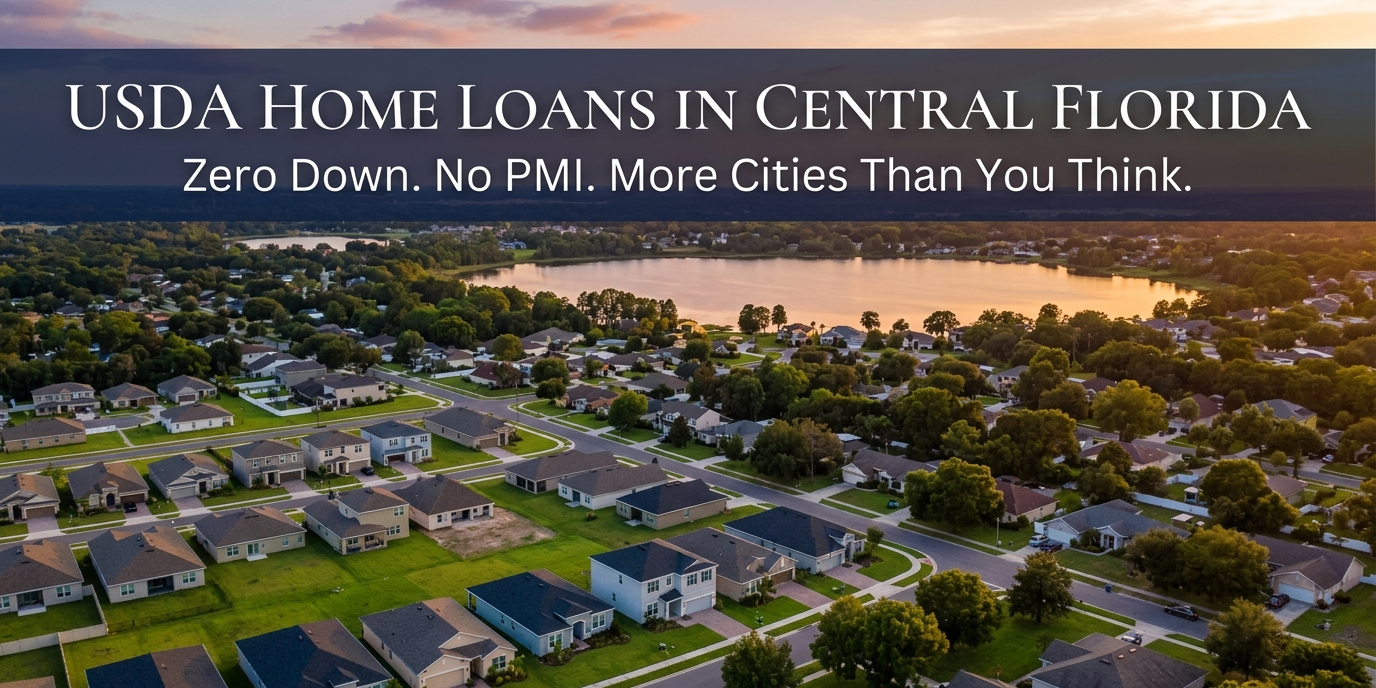
USDA Home Loans in Central Florida: Zero Down, No PMI, and More Cities Than You Think
A plain-language guide to one of the most overlooked homebuyer programs in Florida — and how to find out if your dream city qualifies.
Check My USDA Eligibility → Use the Free CalculatorLet me tell you something I hear at least twice a month: “I didn’t even know that was a thing.”
That’s almost always what a buyer says when I explain USDA home loans. No down payment. No private mortgage insurance. Below-market interest rates. And it’s available in more Central Florida cities than most people — and even most agents — realize.
If you’ve been telling yourself that homeownership is out of reach right now, I want you to read this entire post. Because the USDA loan might be exactly the path you didn’t know existed.
Quick Facts: USDA loans are government-backed mortgages for low-to-moderate income buyers in eligible rural and suburban areas. They require $0 down payment, have no monthly PMI, and offer competitive 30-year fixed rates. Many Central Florida suburbs qualify.
Which Cities and Areas in Central Florida Qualify for a USDA Loan?
This is where most people are surprised. “Rural” doesn’t mean farmland or dirt roads. The USDA defines eligibility based on population thresholds and census designations — and plenty of real Central Florida suburbs make the list.
Eligibility is property-specific. Even within a city, some addresses qualify and others don’t. Always verify at USDA’s official eligibility map or work with a lender who can check it for you in minutes.
| City / Area | County | USDA Eligibility | Notes |
|---|---|---|---|
| Minneola | Lake | ✓ Eligible | Fast-growing suburb; many new builds |
| Groveland | Lake | ✓ Eligible | Affordable new construction available |
| Mascotte | Lake | ✓ Eligible | Smaller community, great starter homes |
| Polk City | Polk | ✓ Eligible | Rural feel, growing fast |
| Haines City | Polk | ✓ Eligible | Parts of city qualify; verify by address |
| Lake Wales | Polk | ✓ Eligible | Charming historic community |
| St. Cloud | Osceola | ✓ Eligible | Outer areas qualify; city center may not |
| Harmony | Osceola | ✓ Eligible | Master-planned community, verify address |
| Christmas | Orange | ✓ Eligible | Rural Orange County enclave |
| Bithlo | Orange | ✓ Eligible | East Orange, many eligible addresses |
| Apopka (outer) | Orange | ⚠ Verify | Some addresses qualify; check map |
| Sanford (rural) | Seminole | ⚠ Verify | Outer Seminole areas may qualify |
| Eustis | Lake | ✓ Eligible | Lake County charm, good inventory |
| Tavares | Lake | ✓ Eligible | “America’s Seaplane City” — yes, it qualifies |
| Leesburg | Lake | ✓ Eligible | Strong value, established neighborhoods |
| Davenport | Polk | ⚠ Verify | Popular with investors; parts qualify |
| Mount Dora | Lake | ✓ Eligible | Arts community; walkable downtown |
Pro Tip: Never assume. Eligibility maps are updated periodically and a neighborhood that qualified two years ago may have been reclassified. Always verify the specific property address before falling in love with a home.
Do You Qualify? Buyer Requirements for a USDA Loan
USDA loans have a reputation for being hard to get. In reality, the requirements are very straightforward — you just need to know what they are before you apply.
1. Income Limits (The Big One)
USDA loans are designed for low-to-moderate income buyers. Your household income — including all adults living in the home — must be at or below 115% of the area’s median income. These limits vary by county and household size.
* Income limits shown are approximate for 2024–2025. Limits increase for households of 5+. Verify current limits at usda.gov or with your lender.
2. Credit Score
Most lenders require a minimum 640 credit score for automated underwriting approval. If your score is between 580–639, you may still qualify through manual underwriting — which means a human underwriter reviews compensating factors like your payment history, savings, and employment stability.
Lower score? Don’t count yourself out. I’ve helped buyers rebuild credit and return ready. It’s a journey, not a wall.
3. Primary Residence Only
USDA loans are for the home you live in. You cannot use a USDA loan to purchase a vacation home, investment property, or Airbnb rental. This is a program built for families putting down roots.
4. U.S. Citizen or Eligible Non-Citizen
You must be a U.S. citizen, U.S. non-citizen national, or a qualified alien. Permanent residents (green card holders) and certain visa holders may qualify. ITIN-only holders generally do not qualify for USDA — but other loan options exist for you. Learn about ITIN loans here.
5. Debt-to-Income Ratio (DTI)
Your total monthly debts (housing + other debts) should ideally be below 41% of your gross monthly income. With strong compensating factors, some lenders will go higher. This is something I calculate upfront with every buyer so there are no surprises.
- 640+ credit score (lower may qualify with manual underwriting)
- Household income at or below 115% of area median
- Property must be in a USDA-eligible area
- Primary residence only — no investment properties
- Steady employment history (typically 2 years)
- U.S. citizen, green card holder, or qualifying visa status
- Property must meet USDA condition standards
- No outstanding federal debt (IRS debt, student loan defaults may affect eligibility)
Not Sure If You Qualify?
I can check your income, credit, and target neighborhood in one free 30-minute call — and I’m both your REALTOR® and your Mortgage Broker. One conversation covers both.
Book a Free USDA Eligibility Call →Property Requirements: What Homes Qualify for USDA Financing?
Not every home in an eligible area will qualify for USDA financing. The property itself must meet certain standards. Here’s what you need to know before you start browsing listings:
Property Types That Qualify
- Single-family homes (most common)
- New construction — yes, you can build with a USDA loan
- Condos and townhomes (must be USDA-approved; check with lender)
- Modular homes (not to be confused with manufactured homes — different rules apply)
- Foreclosures and REO properties (if they meet condition standards)
Property Condition Standards
USDA requires the home to be safe, sanitary, and structurally sound. A USDA appraisal will flag issues like:
- Roof in poor condition (under 2 years of remaining life)
- Foundation cracks or structural damage
- Exposed wiring or outdated electrical panels
- Evidence of pest infestation
- No functional heating/cooling system
- Peeling paint on homes built before 1978 (lead paint concern)
This doesn’t mean the home has to be perfect. Cosmetic issues like dated kitchens, worn carpet, or aging appliances are fine. USDA is looking for habitability — not HGTV-ready condition.
What USDA Does NOT Finance
- Investment properties or rental homes
- Vacation or second homes
- Homes with income-producing acreage (small farms with operating businesses)
- Homes in flood zones without required flood insurance
- Manufactured homes on rented land
Important Things to Know Before You Apply
The USDA Guarantee Fee (This Replaces PMI)
No monthly PMI is a huge USDA benefit — but there is a guarantee fee. Here’s how it works in 2024–2025:
- Upfront guarantee fee: 1% of the loan amount (can be rolled into your loan — zero out of pocket)
- Annual fee: 0.35% of the remaining loan balance, paid monthly
Compare this to FHA’s 1.75% upfront MIP + 0.55% annual MIP, and USDA almost always wins on total cost over time.
USDA Loans Take Slightly Longer to Close
Because USDA loans require a second review from the USDA Rural Development office (after your lender approves the file), closing timelines are typically 30–45 days, sometimes a bit longer. Plan accordingly. If a seller needs a quick 21-day close, a USDA loan may not be the right fit for that specific home.
You Can Use USDA to Build, Not Just Buy
The USDA Section 502 Direct and Guaranteed Loan programs both allow new construction financing in eligible areas. If you’re eyeing a new build in Minneola, Groveland, or Polk City, this is worth exploring. Several builders in Central Florida already have experience with USDA closings.
USDA Does Not Have a First-Time Buyer Requirement
This surprises people. You do not have to be a first-time homebuyer to use a USDA loan. The requirement is that you not own adequate housing at the time of purchase. So if you currently rent, or if your current home is inadequate or in a non-USDA area, you may still qualify even if you’ve owned a home before.
Seller Concessions Are Allowed
USDA allows sellers to contribute up to 6% of the purchase price toward the buyer’s closing costs. In today’s Central Florida market, negotiating this into your offer can make a USDA purchase truly no-money-out-of-pocket.
🏠 USDA Affordability Calculator
This calculator estimates whether a home might fit within USDA guidelines based on your income and estimated payment. It is not a pre-approval — but it gives you a real starting point.
This calculator is for educational purposes only and does not constitute a loan commitment or pre-approval. Actual qualification depends on full underwriting. Contact Stacy for a real analysis.
Frequently Asked Questions About USDA Loans in Central Florida
USDA loans do not have a published maximum loan limit the way FHA and conventional loans do. Instead, your maximum loan amount is determined by your income, debts, and the appraised value of the property. In practice, most USDA purchases in Central Florida fall between $150,000 and $450,000 — though higher amounts are possible depending on qualifying factors.
Most of the City of Orlando and City of Kissimmee do not qualify for USDA financing because their population exceeds USDA thresholds. However, some addresses on the outskirts of these cities may qualify. Communities like St. Cloud, Christmas, Bithlo, and surrounding Lake and Polk County suburbs are much more likely to be eligible. Always verify a specific address on the USDA eligibility map before making assumptions.
Yes. The USDA Guaranteed Loan program requires no down payment whatsoever. You can finance 100% of the purchase price. There is a 1% upfront guarantee fee that can also be rolled into the loan, so many buyers close with virtually nothing out of pocket except their earnest money (which is typically applied to closing costs or returned).
The three key differences: (1) No down payment — FHA requires 3.5% and conventional requires as little as 3% but usually more; (2) No monthly PMI — USDA charges a small annual fee instead of full PMI; (3) Geographic restriction — USDA only applies to eligible rural/suburban areas, while FHA and conventional can be used anywhere. For buyers who qualify in an eligible area, USDA often has the lowest monthly payment of all three.
Most lenders require a 640 minimum credit score for the USDA’s automated underwriting system (GUS). Scores between 580–639 may still qualify through manual underwriting, where a real underwriter reviews your full financial picture. Below 580 is very difficult. If your credit needs work, I can connect you with a credit coach or help you create a plan to get there — it’s what I do.
Possibly, yes. USDA does not require you to be a first-time buyer. The requirement is that you don’t own “adequate, decent, safe, and sanitary housing” at the time of loan closing. If you’re selling your current home to buy in an eligible area, or if your current home is functionally inadequate, you may still qualify. This is evaluated case by case.
Plan for 30–45 days, sometimes up to 60 days depending on USDA’s processing volume. After your lender approves the loan, the file goes to USDA for a “conditional commitment.” During busy seasons, this USDA review can add 1–2 weeks. I always counsel USDA buyers to communicate this timeline to sellers upfront when crafting their offer.
Yes! USDA financing works for new construction in eligible areas. Several builders in Lake County and Polk County communities like Minneola, Groveland, and Haines City have experience with USDA closings. The process adds a few steps (construction draw inspections, etc.) but is absolutely doable. I can connect you with USDA-familiar builders in these areas.
Yes, self-employed buyers can use USDA loans — but income documentation is more detailed. Typically, you’ll need two years of tax returns (personal and business), a year-to-date profit & loss statement, and business bank statements. Your qualifying income is based on your net income after business expenses, not gross revenue. If USDA doesn’t work for your situation, I also offer bank statement loans and P&L-only options through Jhenesis Mortgage.
Ready to Find Out If You Qualify?
I’m a licensed REALTOR® and a licensed Mortgage Broker — which means one conversation with me can tell you whether you qualify for USDA and which homes in the right areas are available right now. No runaround. No passing you to someone else.
Stacy Ann Stephens | REALTOR® | License #BK3393979 | Keller Williams Realty Winter Park · 147 W Lyman Ave, Winter Park FL 32789 · (407) 603-1664
Mortgage Broker NMLS #1933745 | Jhenesis Mortgage NMLS #2532705
Disclaimer: This content is for educational purposes only and does not constitute financial or legal advice. USDA program terms and eligibility areas subject to change.