Orlando Relocation & Neighborhood Guide
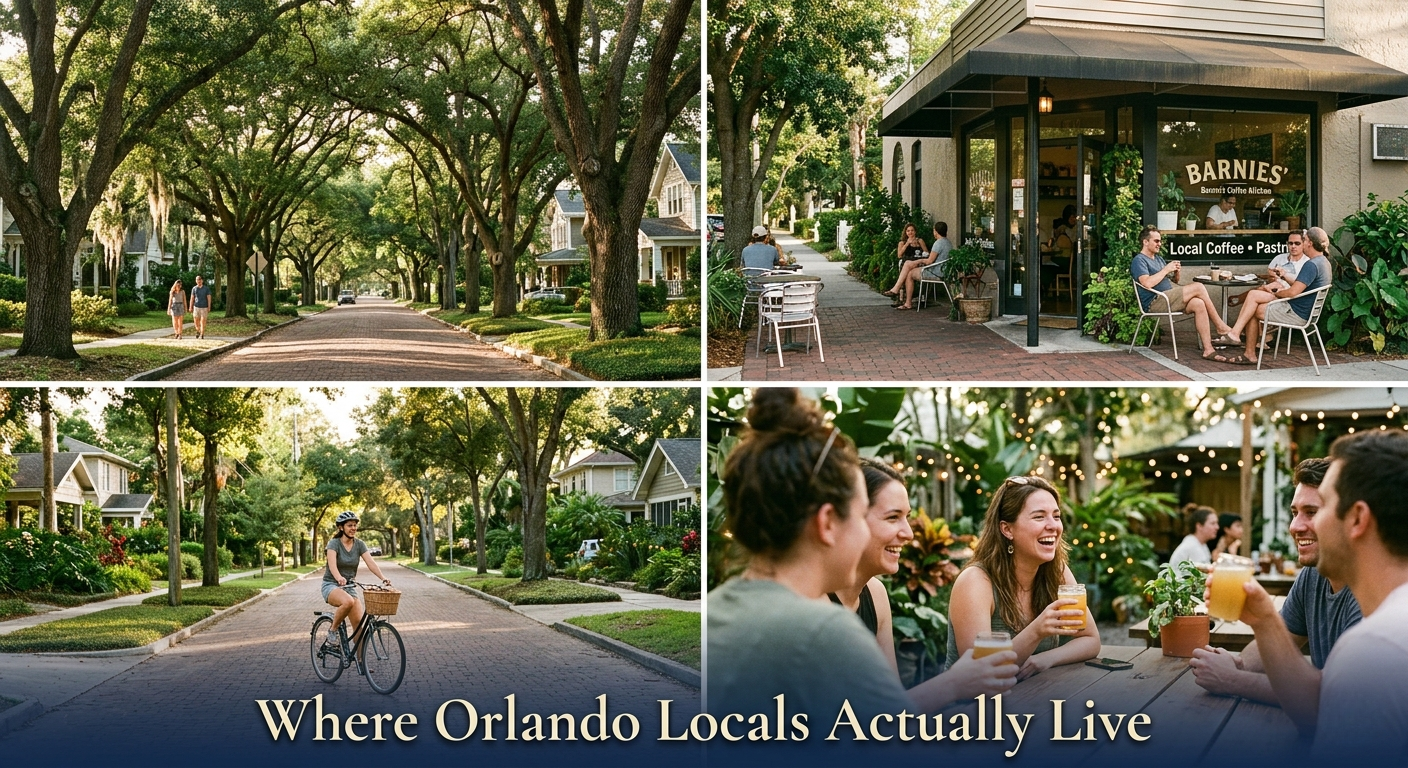
Where Orlando Locals Actually Live: The Real Neighborhood Guide for People Who Hate Theme Parks
The culture-rich, walkable, community-first neighborhoods that out-of-state buyers never discover — until they finally ask someone who lives here.
When people tell me they’re moving to Orlando, there’s always a pause before they say the next part. “But not, like… theme park Orlando.” I hear it constantly. They want the Florida dream — sunshine, space, community — but they don’t want to live next to a 200-acre entertainment complex or spend every Saturday watching tour buses navigate their street.
Good news: Central Florida is not a theme park. The locals know it. And now, so will you.
I’ve lived and worked in this market for over two decades. I’ve watched neighborhoods go from overlooked to underrated to genuinely extraordinary. What follows is the real insider guide — the places I’d tell my own family about, the tradeoffs I’d be honest with them about, and the lifestyle questions you should ask before you pick a zip code.
The “South Florida Fatigue” Buyer — And Why Central Florida Is the Answer
There’s a migration pattern I’ve watched accelerate since 2022: families and professionals leaving Miami, Fort Lauderdale, and Boca Raton for the central part of the state. Not because they don’t love Florida — they do. But the density, the traffic, the cost of living, and the feeling of being surrounded by people who are all passing through on their way somewhere else has worn thin.
Central Florida offers something South Florida rarely does: a sense of permanence. Neighbors who’ve been there for twenty years. Block parties. Farmers markets that are actually for locals. A downtown Orlando arts scene that punches well above its size. Independent restaurants that have been there long enough to have loyal regulars.
Best Walkable Neighborhoods in Orlando for Young Professionals and Families
Here are the neighborhoods I actually show buyers when they tell me they want local flavor, walkability, and community — not another gated subdivision with a water feature at the entrance.
Southeast of downtown Orlando, the Milk District is where the city’s creative class lives. Independent coffee shops, art galleries, vintage stores, and some of the best food trucks in the region. Bungalow homes from the 1940s–1960s, most under 1,500 sq ft, with surprising lot sizes. Prices: $320K–$480K. Walkability score: among the highest in Orlando proper.
Great for: remote workers Arts scene No car needed for dinnerNortheast of downtown, Audubon Park feels like what Orlando was before theme parks. A farmers market that’s been running for years (Audubon Park Community Market, every Wednesday). Local schools with strong PTA involvement. The East End Market — a local food hall — is anchored here. Home prices $380K–$650K.
Great for: families Dog-friendly Community eventsSODO is having a moment. South of the I-408 on the Orange Avenue corridor, it’s a mix of historic bungalows and new construction infill — with easy access to downtown Orlando in 7–10 minutes. Prices are still reasonable ($290K–$430K) and rising steadily. Strong rental demand from young professionals.
Great for: first-time buyers Investors Downtown accessWinter Park is Central Florida’s most established neighborhood. Park Avenue’s brick-paved shopping district, the Rollins College campus, Kraft Azalea Garden on the lakefront — it’s walkable, cultural, and genuinely beautiful. The housing stock ranges from $450K condos to multi-million-dollar lakefront estates. This is my backyard, and it earns the reputation.
Great for: professionals Empty nesters Luxury buyersJust northwest of downtown, College Park has a small-town energy on Edgewater Drive — local restaurants, boutiques, and a slow pace that surprises people who think of Orlando as pure suburb. Home prices $350K–$600K. Walk to dinner. Drive to downtown in 10 minutes.
Great for: families Work-from-home Quiet streetsBaldwin Park is the exception to my usual master-planned skepticism. Built on the former Navy Training Center, it has real urbanism: connected streets, ground-floor retail, lake views, and a trail system. Prices $450K–$900K+. If you want community amenities without the HOA horror stories, Baldwin Park is worth a look.
Great for: active lifestyle Families WalkabilityThe Real Commute Picture — What No One Puts on the Listing
I-4 is genuinely one of the worst highways in America on a bad day. If someone is selling you on a neighborhood without talking about your commute reality, they’re not serving you well. Here’s what the commute landscape actually looks like from each area:
From Winter Park to downtown Orlando: 15–20 minutes. From Audubon Park or College Park: 8–12 minutes. From SODO: 7–10 minutes. From the Milk District: 10–12 minutes. From Baldwin Park: 15–20 minutes.
The key is avoiding I-4 wherever possible. For most of these neighborhoods, you can reach downtown, the airport (MCO), and major employment corridors via surface roads — SR-408, SR-417, US-17/92, or simply Orange Avenue. I map this for every buyer I work with before we look at a single house.
📍 Neighborhood Match Finder
Tell me what matters most to your lifestyle and I’ll point you toward the neighborhoods that actually fit.
What Out-of-State Buyers Get Wrong About Orlando (And How to Avoid It)
The biggest mistake I see relocation buyers make is Googling “best Orlando neighborhoods” and ending up with a list written by someone who has never walked Park Avenue or had a Saturday breakfast at a local diner in Audubon Park. The top search results are often aggregator content built on Zillow data — not local knowledge.
The second mistake is underestimating how neighborhood-by-neighborhood the market is. A mile can mean the difference between an established canopy-tree block where homes appreciate steadily and a newer subdivision where everyone is selling at the same time because the builder offered move-up incentives. I’ve watched both patterns play out hundreds of times.