
Florida Home Buying Guide · Due Diligence
Property Survey When Buying a Home in Florida: Types, Costs, Red Flags, and What Every Buyer Must Know
Your lender may require one. Your title company needs one to fully protect you. And you need one to know exactly what you’re actually buying.
Four Types of Property Surveys in Florida — and Which One You Need
📐 Standard Boundary Survey
The most common residential survey. Establishes property corners and boundary lines, shows structures on the lot, identifies visible encroachments and easements. Most lenders accept this.
📋 ALTA/NSPS Survey
The gold standard. Documents everything in a boundary survey plus recorded easements, utility lines, access rights, setbacks, zoning classifications. Required for commercial; sometimes required by lenders on complex residential deals.
🌊 Boundary + Elevation Certificate
Standard boundary survey plus an elevation certificate showing the home’s height relative to the base flood elevation. Required by lenders for flood zone properties. Strongly recommended in any Zone AE or VE property.
🗺️ Topographic Survey
Maps the contours and elevation changes of the property. Typically needed for new construction, significant grading or drainage projects, or complex waterfront properties.
Why the Survey Exception in Your Title Policy Matters
Every title commitment includes a survey exception in Schedule B-II — meaning the title policy won’t cover boundary disputes, encroachments, or easements that a current survey would have revealed. Provide the title company with a current survey showing no issues, and they can remove that exception, giving you meaningfully stronger protection. It’s one of the most underused tools in the Florida buyer’s toolkit.
Survey Cost Estimator
🧮 Florida Property Survey Cost Estimator
Get a realistic cost range based on your property type and survey needs.
Ranges are estimates. Get 2–3 quotes from licensed Florida surveyors. Turnaround and pricing vary by market conditions and surveyor workload.
Red Flags on a Property Survey: What Should Pause Your Closing
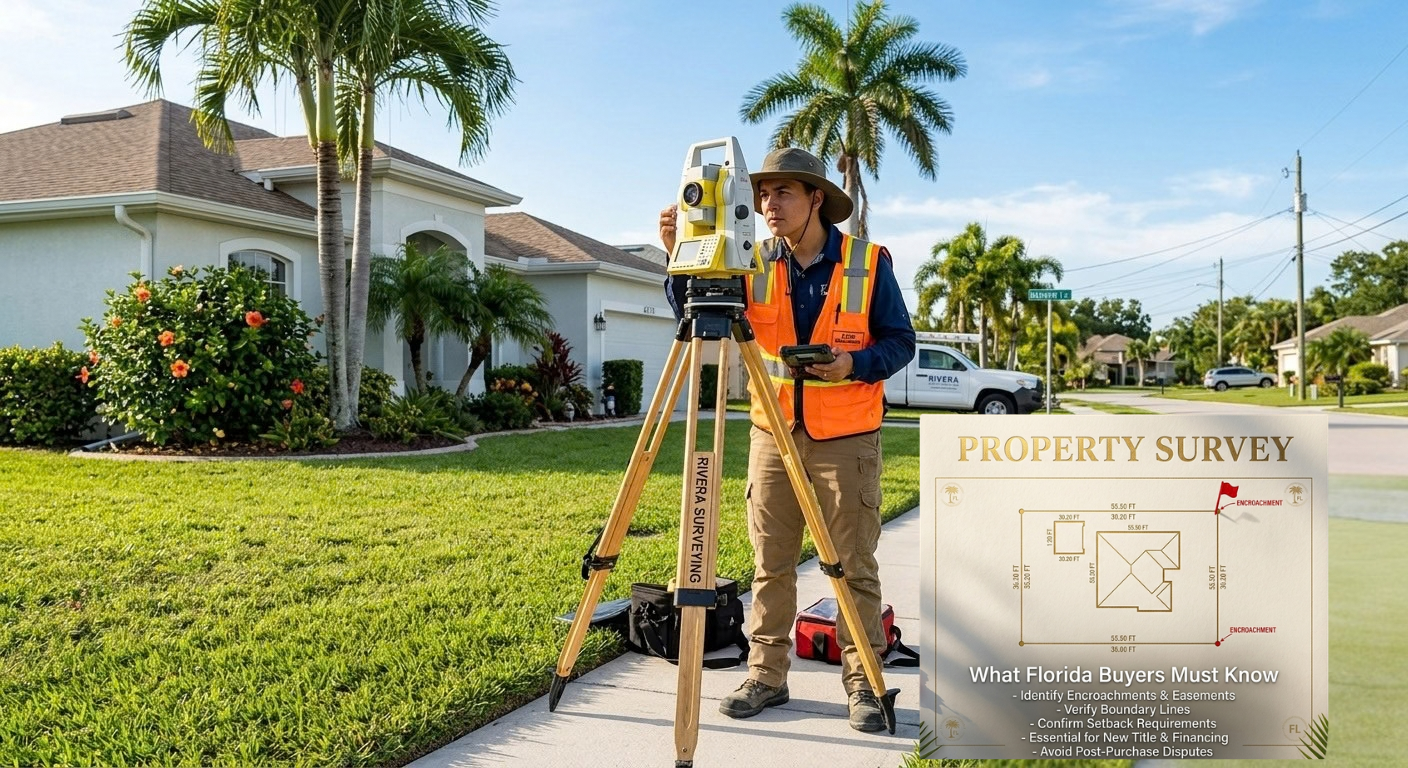
- Neighbor’s structure on your lot (encroachment onto you) — A fence, shed, driveway, or addition sitting on your side of the boundary line. The neighbor may have a claim to that land through adverse possession if it’s been there long enough. Requires a boundary line agreement, removal, or price renegotiation.
- Seller’s structure on neighbor’s lot (you encroaching on them) — More serious. A pool cage, addition, or outbuilding that crosses the boundary means you’re encroaching on the neighbor at closing. The neighbor can require removal, sue for damages, or refuse easement access. This is a title issue.
- Setback violation — A structure sits closer to the property line, road, or waterway than zoning allows. Often means the structure was built without permits or was built incorrectly. May require after-the-fact permitting, a variance, or in serious cases, removal.
- Fence doesn’t match the boundary line — Very common in Florida. A fence 2–5 feet inside the actual boundary has been mistaken for the property line for years. You may be losing usable yard you legally own — or the seller may have been using the neighbor’s yard. Either way, it needs to be clearly understood.
- Utility easement crossing the buildable area — A utility easement can prevent you from building structures, planting certain trees, or making improvements in that zone. Make sure the easement location doesn’t conflict with your plans for the property.
- Drainage or conservation easement — Limits what you can do with that portion of land. Especially common in Central Florida where water management districts have rights over drainage corridors. Can significantly affect usable yard space.
- Unpermitted structures visible on survey — A structure that appears on the survey but has no recorded permit history is a code enforcement risk that transfers to you. Request a permit search to confirm every structure on the survey has a completed permit on file.
- Access issues (no deeded access to public road) — Rare but serious. If the property doesn’t have legal access to a public road — only a prescriptive path or informal access — you may not be able to get title insurance, obtain a mortgage, or sell the property later.
- Boundary dispute with adjacent property — Conflicting surveys between neighboring properties, contested corners, or disputed lot lines require legal resolution before closing. Don’t assume it’ll work itself out.
- Waterfront: dock, seawall, or boat lift without permits — Waterfront structures are highly regulated in Florida. A dock or seawall installed without permits from the appropriate water management district can result in mandatory removal at your expense.
Survey Red Flag Checklist — Print or Save Before Your Closing
- Survey shows no encroachments in either direction
- All structures are within setback requirements
- Fence lines match the actual property boundaries
- Easements are reviewed and acceptable for my plans
- Property has legal, deeded access to a public road
- All structures on survey have completed permits on file
- Elevation certificate obtained (if flood zone property)
- Survey exception removed from title commitment
- Waterfront structures (if any) have all required permits
- Any boundary discrepancies resolved before closing date
Frequently Asked Questions
Is a survey required to buy a house in Florida?
Not legally required by state law, but almost always required by your lender and strongly advisable for your own protection. Without a current survey, your title policy will contain a survey exception — meaning you’re not covered for boundary disputes or encroachments that a survey would have revealed. Order it early in your due diligence window.
Who pays for the survey when buying a home in Florida?
The buyer typically pays for the survey as part of closing costs in Florida. It’s one of the due diligence expenses you control — order it once you’re under contract, from a licensed Florida surveyor. Budget $350–600 for a standard residential boundary survey, more for waterfront or complex properties.
What is an encroachment and how serious is it?
An encroachment means something physically crosses the property boundary where it shouldn’t — either a neighbor’s structure on your land, or a structure from the property you’re buying that extends onto a neighbor’s land. Both need resolution. The second type is especially serious because it creates a title issue and may expose you to a neighbor’s claim at any point in the future.
What is a setback violation?
Zoning codes require structures to sit a minimum distance from property lines, roads, and waterways. A setback violation means a structure was built too close. It often signals unpermitted work. Depending on the severity, it may need to be legalized through a variance, corrected, or disclosed and priced accordingly.
Do I need an elevation certificate in Florida?
If you’re in FEMA flood zone AE or VE, your lender requires it. Even in lower-risk zones, an elevation certificate can significantly reduce your flood insurance premium if your home sits above the base flood elevation. In Florida, flood insurance is a major ongoing cost — a $400–600 elevation certificate investment often pays for itself quickly.
What should I do if the survey shows a problem?
Don’t close until it’s addressed. Bring it immediately to your agent (that’s me) and your real estate attorney. Your options — boundary line agreements, permits, price adjustments, or walking away — depend on the specific issue. Most survey problems are resolvable; the key is finding them before closing, not after.
I Make Sure Your Survey Gets Ordered, Reviewed, and Understood
A property survey is one of the most important due diligence tools in your Florida transaction. I’ll help you understand what it says — and what to do if it shows a problem.
Let’s Talk About Your Purchase