S
Stacy Ann Stephens | REALTOR® · 24 Years Central Florida
Keller Williams Realty Winter Park · 147 W Lyman Ave, Winter Park FL 32789 · 407-603-1664 · License #BK3393979
This week alone, I’ve spoken to two homeowners facing situations that — if they had understood their title rights and protections earlier — might have been prevented or resolved more quickly. Their stories reminded me that a lot of people who own homes in Florida don’t really understand what they own, how their ownership is legally protected, and what can threaten it.
This guide is the one I wish I could hand to every buyer at closing — and every current homeowner who has never had this conversation. Because your home may be your most valuable asset, and your title is the legal structure that protects everything about it.
~60%
Florida closings require resolving title issues first (industry 2026)
$275M+
Real estate fraud losses reported to FBI in 2025 — rising fast
$40K
Average CFPB-reported owner’s title claim when a defect surfaces
Free
Florida county property fraud alert service — most homeowners haven’t registered
The Plain-English Difference: Title vs. Deed
🎙️ Direct Answer — Voice & AI Search
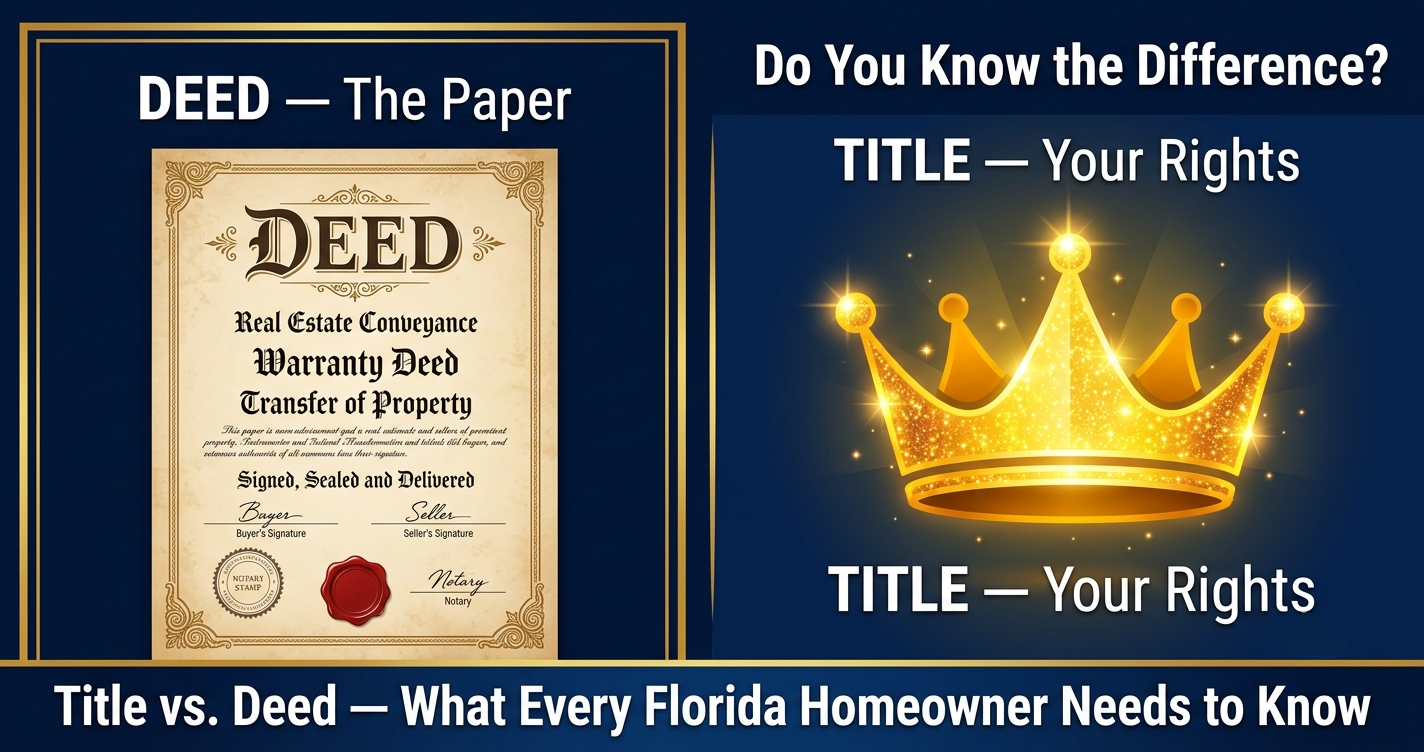
In Florida, the title is your legal right to own, use, and transfer property — it is not a physical document but a bundle of legal rights. The deed is the physical legal document that transfers the title from the seller to the buyer and is recorded with the county clerk. When you buy a home, you receive a deed at closing; that deed transfers the title to you. The title represents what you own; the deed proves the transfer happened.
📜 DEED
- What it is: A legal document — physical, signed, notarized
- Purpose: Transfers ownership from seller to buyer
- Created: At or before closing
- Filed: Recorded with county clerk’s office
- Public record: Yes — anyone can look it up
- Protects: Documents that a transfer occurred
- Florida requirement: Must be signed, witnessed by 2 people, notarized, and recorded to be legally valid
👑 TITLE
- What it is: A legal concept — your bundle of ownership rights
- Purpose: Represents your right to possess, use, exclude, and sell
- Created: When ownership is transferred to you via deed
- Filed: Not filed — reflected in the totality of property records
- Public record: Represented through the chain of recorded instruments
- Protects: Your legal ownership rights against competing claims
- Florida requirement: Must be “clear” — free of liens, encumbrances, or competing claims — for a sale or refinance to close
Here is the practical way to remember it: the deed is the event — the moment of transfer. The title is the status — your ongoing ownership rights. You can lose your title to a defect discovered years after the deed was recorded. That’s why “clear title” and title insurance exist.
The 5 Types of Deeds Used in Florida — and Why Each Matters
🎙️ Direct Answer
Florida uses five main deed types in residential real estate: the general warranty deed (the strongest buyer protection — seller guarantees clear title throughout the entire chain of ownership), the special warranty deed (seller only guarantees the period they owned it), the quit claim deed (no warranties — just transfers whatever interest the grantor has, used for family transfers and title corrections), the trustee’s deed (used when a trust transfers property), and the personal representative’s deed (used in estate transactions). Most residential purchases use a general warranty deed.
General Warranty Deed
Standard home purchase — strongest protectionThe seller guarantees clear title going back through the entire history of ownership — not just their time of ownership. If a defect surfaces from any prior owner, the seller is liable. This is the gold standard for buyer protection and is used in most Florida residential purchases.
Special Warranty Deed
Common in bank/REO sales, commercialThe seller only guarantees title for the period they owned the property. If a defect predates their ownership, they are not responsible. Common when banks sell foreclosure properties or REOs. Buyers should be especially diligent with title insurance when receiving a special warranty deed.
Quit Claim Deed
Family transfers, title correctionsNo warranties at all. The grantor transfers whatever ownership interest they have — which may be everything, something, or nothing. Used for: adding a spouse to title, removing an ex-spouse post-divorce, family property transfers, and correcting name errors. Never use a quit claim deed in an arm’s length purchase without full title search and insurance.
Trustee’s Deed
Trust-held property transfersUsed when property held in a trust is being transferred. The trustee signs on behalf of the trust. Increasingly common as more Floridians use revocable living trusts for estate planning and homestead protection.
Personal Rep. Deed
Estate / probate salesUsed by a personal representative (executor) when selling property from a deceased owner’s estate. Requires probate court oversight. Estate sales and inherited properties often use this deed type — title searches in these transactions are especially important.
What “Clear Title” Means — and What Can Cloud It
🎙️ Direct Answer
A clear title means the property’s ownership history is free of liens, judgments, competing claims, recording errors, or encumbrances that could affect the buyer’s ownership rights. In Florida in 2026, title defects found in approximately 60% of closings include: unpaid contractor or HOA liens, judgments against prior owners, unreleased mortgages from past refinances, boundary disputes, errors in the legal description, signatures missing from prior deeds, and claims from unknown heirs. Most are resolved before closing — but undetected defects can surface years later.
Title defects that come up most frequently in Central Florida transactions:
- Unpaid contractor liens: A prior owner hired a contractor who wasn’t fully paid and recorded a mechanic’s lien. The lien follows the property — not the person.
- Unreleased mortgages: A prior loan was paid off but the release of lien was never recorded. The old mortgage still shows in the public record.
- HOA liens: Unpaid HOA assessments can become a lien and must be resolved before any sale or refinance can close.
- Missing or improperly executed signatures: A prior deed was signed by only one spouse when both were required. The unsigning spouse (or their heirs) may still have a claim.
- Errors in the legal description: The property’s legal description in a prior deed doesn’t exactly match current records. Can take weeks or months to correct through a quiet title action.
- Unknown heirs: A prior owner died without a clear will. A distant heir surfaces years later claiming an interest in the property.
This is why title insurance exists. Owner’s title insurance protects you against defects that weren’t discoverable at closing — including those arising from prior ownership. It is purchased once at closing (typical cost: 0.5–1% of purchase price, approximately $1,500–$3,000 on a $300,000 home in Florida) and protects you for as long as you own the property. The average claim when a defect surfaces: $40,000. Skipping owner’s title insurance to save at closing is one of the most expensive mistakes Florida buyers make.
Buying or Selling in Central Florida? Your Title Needs an Expert Eye Before You Sign.
Every transaction I handle includes a complete title review as part of the process — because protecting your ownership rights from Day 1 is part of what I do. If you have questions about your current title, a prior deed, or an upcoming purchase or sale, call me.
📞 Call Stacy: 407-603-1664Frequently Asked Questions
What is the difference between a title and a deed in Florida?+
In Florida, the title is your legal right to own, use, and transfer property — it is a bundle of ownership rights, not a physical document. The deed is the physical legal document signed at closing that transfers the title from the seller to the buyer and is recorded with the county clerk. When you buy a home, you receive a deed; that deed transfers the title to you. The deed is the event; the title is the ongoing status of your ownership rights.
What does “clear title” mean in Florida real estate?+
Clear title means the property’s ownership history is free of liens, judgments, competing claims, recording errors, or encumbrances that could affect the buyer’s ownership rights. Before closing, a title search reviews the public record going back as far as necessary to confirm the title is clear. If defects are found — such as an unreleased prior mortgage, a contractor lien, or an improperly signed prior deed — they must be resolved before the transaction can close.
Is owner’s title insurance required in Florida?+
Owner’s title insurance is not legally required in Florida — but it is strongly recommended for every buyer. Lender’s title insurance is typically required by your mortgage lender, but it only protects the lender’s interest, not yours. Owner’s title insurance protects you against defects that weren’t discoverable at closing — including those that surface years later from prior ownership. It is purchased once at closing and protects you for as long as you own the property. The typical cost in Florida is 0.5–1% of the purchase price.
What is a quit claim deed and when is it used in Florida?+
A quit claim deed transfers whatever ownership interest the grantor has in a property — with no warranties about the quality or completeness of that interest. It is commonly used in Florida for: adding or removing a spouse from title after marriage or divorce, transferring property between family members, placing property into a trust, and correcting errors in a prior deed. Quit claim deeds are not appropriate for standard arm’s-length sales between buyers and sellers who don’t know each other, because the seller provides no guarantee that they actually have clear title.
What is title fraud and how can I protect my home in Florida?+
Title fraud — also called deed fraud — occurs when a criminal forges your signature on a deed and records it with the county clerk, fraudulently transferring your property to themselves or a third party. They may then attempt to sell or mortgage the property. Florida counties are now required to offer free property fraud alert services — registering allows you to receive instant notification when any document is recorded against your property or name. Most homeowners have not yet registered. Find your county’s alert service by searching “[county name] Florida property fraud alert.”
What happens if there is a lien on my property title in Florida?+
If a lien — such as an unpaid contractor’s mechanic’s lien, an HOA assessment lien, or a judgment lien — is on your title, it must typically be satisfied (paid off) or released before you can sell or refinance. In a sale, liens are often paid from the seller’s proceeds at closing. In some cases, liens can be negotiated down or removed through a quiet title action if they are invalid. Failing to identify and address liens before listing can cause a contract to fall apart after inspection, when the buyer’s title search discovers the defect.
Your Ownership Is Only as Strong as Your Title Protection
Whether you’re buying, selling, or just want to make sure your current ownership is protected — I’m here to help you understand what you have and what steps to take. All consultations are confidential.
📞 407-603-1664 — Free ConsultationS
Stacy Ann Stephens | REALTOR®
Keller Williams Realty Winter Park · 147 W Lyman Ave, Winter Park FL 32789 · 407-603-1664 · License #BK3393979
For informational purposes only. This post does not constitute legal advice. Consult a licensed Florida real estate attorney for guidance specific to your situation.