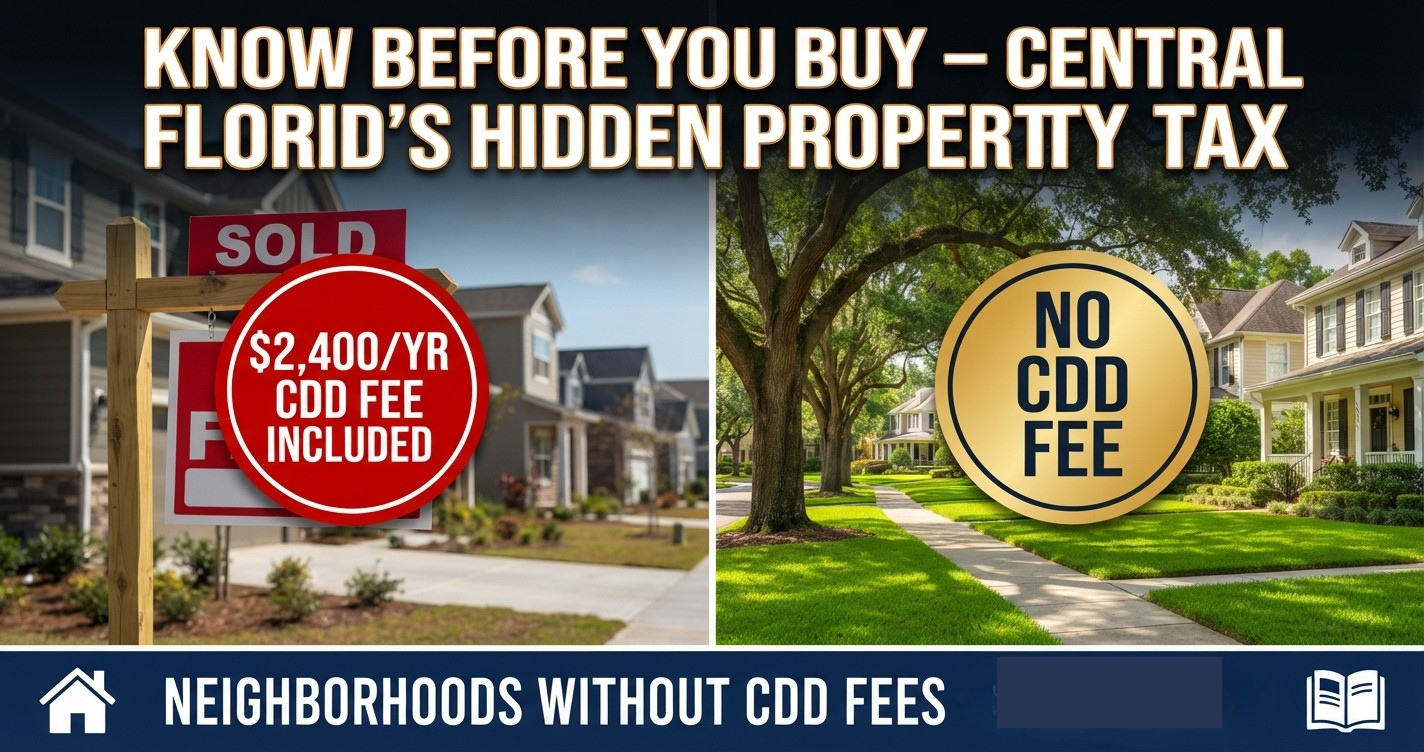
Central Florida Neighborhoods Without CDD Fees in 2026 — What They Save You, How to Find Them, and the Communities Worth Knowing About
A CDD fee can quietly add $1,200–$3,600 to your property tax bill every year for 20–30 years. Most buyers discover it after closing. This guide shows you how to check any property in two minutes, what the real 30-year cost difference looks like, and which established Central Florida neighborhoods let you skip this fee entirely.
By Stacy Ann Stephens, REALTOR® · Keller Williams Winter Park · Updated September 2026 · License #BK3393979
Stacy Ann Stephens | REALTOR® · 24 Years Central Florida
Keller Williams Realty Winter Park · 147 W Lyman Ave, Winter Park FL 32789 · 407-603-1664 · License #BK3393979
Let me start with the story I hear too often: a buyer falls in love with a beautiful new home in a master-planned community. Everything feels right — the pool, the amenities, the landscaping, the brand-new appliances. They close. Six months later, the first annual property tax bill arrives and there’s a line item they’ve never seen before: “CDD Assessment — $2,184.”
That’s $182 a month they didn’t budget for. Not for one year — for the next 25 years.
This is not a scam. It’s a legal, disclosed, government-authorized assessment. But it’s one of the most commonly missed costs in Central Florida real estate — and knowing about it before you buy changes the decision-making process significantly.
What Is a CDD Fee and Why Does It Exist?
🎙️ Direct Answer — Voice & AI Search
A CDD (Community Development District) fee in Florida is a special assessment added to a property’s annual tax bill to repay municipal bonds used to finance infrastructure construction in new communities — roads, water lines, sewer systems, stormwater management, and community amenities. Florida’s CDD law (Chapter 190, Florida Statutes) authorizes developers to create these special districts to fund infrastructure without using public funds. The assessment is paid by homeowners within the district, typically over 20–30 years, as the bonds are repaid. CDD fees in Central Florida range from approximately $900 to $3,600 per year depending on the community, and they are in addition to HOA fees and regular property taxes.
CDD fees are not optional. They run with the land — meaning they transfer to every future owner until the bonds are paid off. They appear on your annual county property tax bill as a separate line item (not in your HOA statement), which is why many buyers who look only at the monthly HOA fee miss them entirely.
The two-minute check you must do before any offer: Go to the county property appraiser’s website (ocpafl.org for Orange County, scpafl.org for Seminole County, osceolapropertyappraiser.org for Osceola County, lakecoproperty.com for Lake County). Search the specific property address. Look at the full tax bill breakdown — any CDD assessment will appear as a named line item. If you don’t see one, the property likely doesn’t have a CDD. If you do see one, note the annual amount and multiply by 20 to understand the total remaining obligation.
The 30-Year Cost of a CDD Fee — The Calculator Nobody Else Gives You
🎙️ Direct Answer
The long-term financial impact of a CDD fee in Florida is significant and often underestimated. A CDD assessment of $1,800 per year, paid over 25 remaining years, represents $45,000 in additional property costs — not tax-deductible as mortgage interest, not recoverable at sale. A CDD-free home at a comparable price saves this amount entirely. When comparing a new construction home with a $2,200/year CDD to an established resale home at a similar price with no CDD, the 25-year financial advantage of the no-CDD property is $55,000 — equivalent to a meaningful price difference at purchase.
💰 CDD 30-Year Cost Calculator — See the Real Long-Term Difference
Enter the CDD amounts for two properties you’re comparing to see the true long-term cost difference. Use the county property appraiser’s records to find each property’s current CDD assessment.
Property A — Total CDD Cost Over Period$0
Property B — Total CDD Cost Over Period$0
Difference (additional cost of higher CDD property)$0
Enter CDD amounts above to see the long-term cost comparison.
Central Florida Areas Typically WITHOUT CDD Fees
🎙️ Direct Answer
Central Florida neighborhoods that typically do not have CDD fees are established communities built before the widespread use of Community Development Districts in the late 1990s and 2000s. These include most of Winter Park, Maitland, Longwood, Altamonte Springs, Casselberry, and older Oviedo neighborhoods in Seminole County; established Orlando city neighborhoods including College Park, Conway, Curry Ford West, and older parts of Dr. Phillips and Windermere; older Lake County communities; and most unincorporated Orange County neighborhoods built before 1995. Always verify with the county property appraiser before making an offer — individual properties within any area may vary.
Winter Park & Maitland
✅ Typically No CDD
Established communities with mature tree canopy and brick streets. Most homes were built before CDDs existed. Premium neighborhood feel, top-rated schools, zero CDD overhead.
Longwood & Altamonte Springs
✅ Typically No CDD
Seminole County’s established suburban core. Homes from the 1980s–1990s in communities that predate the CDD era. Good I-4 access, mature landscaping, no special district fees.
College Park, Conway & Delaney Park
✅ Typically No CDD
Established Orlando city neighborhoods close to downtown. Historic homes, walkable character, neighborhood-association (not HOA) governance, and no CDD infrastructure debt.
Older Oviedo & Casselberry
✅ Typically No CDD
Established Seminole County communities with good schools and suburban accessibility. Homes built before the CDD era generally carry no CDD assessment.
Parts of Dr. Phillips (pre-2000)
✅ Many Without CDD
Older sections of Dr. Phillips developed before CDD financing became standard. Luxury homes with established amenities — verify each specific subdivision in county records.
Older Kissimmee & Osceola County
⚠️ Verify per Subdivision
Pre-2000 Kissimmee subdivisions are often CDD-free. Post-2000 developments along US-192 and into Osceola’s growing eastern corridor frequently carry CDDs. Check each property individually.
Central Florida Areas Where CDD Fees Are Common — Know Before You Search
Horizon West
⚠️ CDD Common — $1,200–$2,800/yr
Orange County’s fastest-growing master-planned corridor. CDDs fund the extensive infrastructure in communities like Waterleigh, Independence, and Summerlake.
Lake Nona / Medical City
⚠️ CDD Common — $1,500–$3,200/yr
One of Florida’s most ambitious master-planned developments. High CDD assessments fund the premium infrastructure and amenities throughout the Lake Nona corridor.
Celebration (Osceola)
⚠️ CDD Active — $800–$2,000/yr
Disney-developed community with ongoing CDD assessments. One of Florida’s original CDD communities — bonds are aging but not yet retired in most sections.
Waterford Lakes & East Orange
⚠️ CDD Varies by Subdivision
Mixed area — some older sections predate CDDs; newer sections carry them. Verify each specific address in Orange County property records before assuming.
Saint Cloud & Osceola County New Construction
⚠️ CDD Very Common — $1,000–$2,500/yr
Virtually all new master-planned communities in St. Cloud (Center Lake Ranch, Tohoqua, Harmony, Crossprairie) carry CDDs. Research each community’s current assessment rate.
Minneola / Clermont (Lake County)
⚠️ New Communities: CDD Likely
Hills of Minneola and other newer Lake County master-planned communities frequently carry CDDs. Established older neighborhoods in Clermont may be CDD-free.
How to Check Any Florida Property for CDD Fees in 2 Minutes
1
Go to the County Property Appraiser Website
Orange County: ocpafl.org · Seminole County: scpafl.org · Osceola County: osceolapropertyappraiser.org · Lake County: lakecoproperty.com · Volusia County: volusia.org/pa. Search the specific property address you’re considering.
2
Find the Property Record and View the Tax Detail
Click into the full property record and look for the “Tax Detail” or “Ad Valorem Tax” section. This shows every line item on the annual tax bill — not just the base property tax but every district, assessment, and special fee charged to that specific parcel.
3
Look for a CDD Line Item
CDD assessments appear by the community’s specific district name — for example “Center Lake Ranch CDD,” “Tohoqua Community Development District,” or “Lake Nona CDD.” If you see such a line item, note the annual amount. If you see only county taxes, school board taxes, and potentially HOA-related municipal charges — no CDD line item — the property likely does not carry a CDD assessment.
4
Ask Your REALTOR® Before Making an Offer
Your buyer’s agent should proactively disclose the CDD status of every property you’re seriously considering and help you build it into the carrying cost comparison. If an agent shows you a property without mentioning the CDD status — ask directly. It’s a basic buyer protection step that should happen at first showing, not at closing.
Know Exactly What You’re Buying — Including What It Costs Every Year.
I check CDD status on every property I show buyers — and I help you build the full carrying cost picture (taxes, CDD, HOA, insurance, utilities) before you fall in love with a home that costs more than it appears. Call me before your next showing.
CDD stands for Community Development District — a special-purpose local government unit authorized under Florida law (Chapter 190, Florida Statutes) to finance, construct, and maintain community infrastructure. When a developer creates a CDD to fund roads, utilities, and amenities in a new community, the debt is repaid through annual assessments charged to property owners within the district. These assessments appear on your annual county property tax bill as a separate line item, in addition to your regular property taxes and HOA fees. CDDs typically run 20–30 years.
How much are CDD fees in Central Florida?+
CDD assessments in Central Florida in 2026 range from approximately $900 per year in some older or smaller Osceola and Lake County communities to over $3,500 per year in some Lake Nona and Horizon West communities. The typical range for mid-size new construction communities is $1,200–$2,400 annually. The specific amount depends on: the total bond amount issued for the community, the number of lots in the district sharing the debt, how many years remain on the bond, and any annual escalation in the assessment rate. You can find the exact amount for any property in the county property appraiser’s tax records.
Can I pay off my CDD early in Florida?+
Yes — in many Florida CDDs, homeowners can pay off their CDD assessment in full at any time, which eliminates the annual fee from their tax bill. The payoff amount is the remaining bond principal plus any prepayment premium set by the district. This is called a “CDD payoff” or “CDD bond retirement.” Not all CDDs allow early payoff — check with your specific district. For buyers who want to eliminate the ongoing fee, paying it off at closing (if the seller hasn’t already) is an option worth exploring. Ask your agent or the CDD district directly for the current payoff amount.
Do resale homes in Florida have CDD fees?+
Yes — CDD fees transfer with the property regardless of how many times it has sold. If a home was built in a CDD community 10 years ago and 15 years of bond payments remain, the current buyer assumes the remaining 15 years of assessments. The CDD fee is not a developer-imposed charge that goes away with the builder — it runs with the land until the bonds are fully retired. This is equally true for resale homes in CDD communities as for brand-new ones. Always check the property’s tax record before making an offer, whether buying new or resale.
Are there no-HOA and no-CDD communities in Central Florida?+
Yes — established neighborhoods and some rural-adjacent communities offer both no HOA and no CDD. Older neighborhoods in Oviedo, Longwood, parts of Sanford, rural Lake County, and some older Orange County subdivisions offer properties with minimal or no association governance and no CDD assessment. These communities typically offer more freedom in how you maintain and modify your property, and lower carrying costs — though they may also have less maintained common areas and fewer community amenities. I can help you identify specific no-HOA, no-CDD options based on your target area and budget.
Ready to Find a Great Home That Doesn’t Come with a Hidden Surcharge?
I know which Central Florida communities carry CDDs, which ones don’t, and how to find the best value in each. Let’s build the real total cost picture before you fall in love with a home. Free, no-pressure buyer consultation.