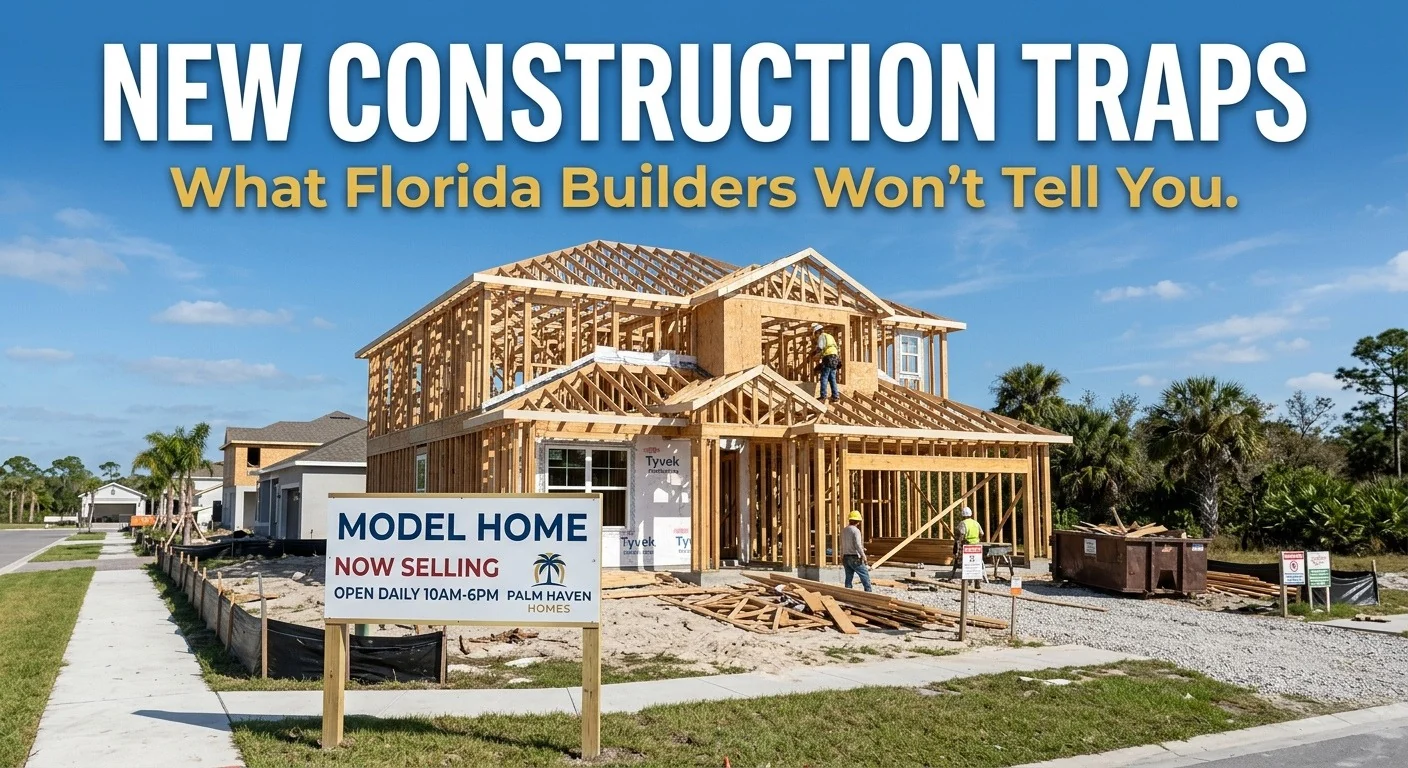
Buying New Construction in Florida: What Builders Won’t Tell You (2026 Buyer Guide)
New construction seems simple — pick your lot, choose your finishes, move in. But Florida’s builder contracts are written to protect one party. It isn’t you.
There’s a reason people love the idea of new construction. Fresh everything. Builder warranty. No one else’s carpet or questionable renovation to work around. In a market where resale inventory is tight, new builds look even better.
But here’s what I’ve seen happen to buyers who go in without preparation: they use the builder’s lender without comparing options and end up with a higher rate. They skip the independent inspection because “it’s brand new.” They sign an upgrade agreement without realizing the markup is 200% over what a contractor would charge after closing. And the agent in the sales office who seemed so helpful? Their license requires them to represent the builder.
None of this means you shouldn’t buy new construction in Florida. It means you should know exactly what you’re walking into.
The Builder’s Lender Trap
When you buy from a Florida builder, you’ll almost always be offered an incentive to use their “preferred lender.” The incentive can be real — closing cost credits, rate buydowns, upgrade allowances — sometimes worth $5,000 to $15,000 or more. That gets your attention.
Watch Out
The incentive isn’t always the best deal. Builders earn revenue from their preferred lender partnerships. The incentive can come packaged with a rate that’s 0.25%–0.5% higher than what an independent lender would offer. Over a 30-year loan, that difference can exceed the value of the incentive by a wide margin.
What to do instead: get a full loan quote from an independent lender before accepting the builder’s offer. Compare the total loan cost — rate, APR, fees — not just the upfront credit. If the builder’s preferred lender is genuinely competitive, great. If not, the independent option may save you significantly more over the life of the loan. Some builders allow buyers to use their own lender while still receiving a reduced form of the incentive — always ask.
The Agent in the Sales Office Works for the Builder
This is probably the most misunderstood thing about new construction in Florida. The friendly agent at the model home is a licensed real estate professional — but their client is the builder, not you. They are legally obligated to protect the builder’s interests in every aspect of the transaction.
That doesn’t mean they’re dishonest. It means their loyalty is not yours. When questions arise about contract terms, closing timelines, or upgrade negotiations, they will advocate for the outcome that works for the builder.
Important: Florida new construction communities require you to register your buyer’s agent on your very first visit. If you tour the community unrepresented and return with an agent later, most builders will refuse to allow that agent to participate in the transaction. If you plan to have your own representation — which you should — bring them from the start.
Your buyer’s agent reviews the contract from your perspective, identifies unfavorable terms, negotiates on your behalf, and guides you through the process. In most new construction transactions, the builder pays the buyer’s agent commission — so having your own representation costs you nothing.
The Upgrade Pricing Reality
Builder model homes are designed to show you the premium version of everything. The price you see on the lot is the base price — with builder-grade finishes. Everything that made the model look that good is an upgrade, priced through the builder’s design center at margins that can reach 200–300% of what you’d pay a contractor post-closing.
Some upgrades make sense to do through the builder: structural changes (vaulted ceilings, room additions, window placements) can only be done during construction, and builder warranty usually covers them. Cosmetic finishes — flooring, countertops, cabinets, lighting — can often be changed after closing at a fraction of the builder’s design center price.
The strategy used by experienced buyers: take the base home, budget separately for post-closing upgrades, and finance through the mortgage only what truly needs to be in the builder’s scope. Have your agent run the numbers on specific upgrades before the design center appointment.
New Construction Due Diligence Checklist
Use this checklist before and during your new construction purchase. Check off each item as you complete it.
New Construction Due Diligence Checklist
Tap each item to mark it complete. Track your progress below.
0 of 20 items completed
Before You Sign Anything
Register your buyer’s agent on your very first visit to any community Get a quote from an independent lender before comparing the builder’s preferred lender offer Research builder reputation: BBB, Google reviews, NextDoor posts in nearby communities, state contractor license history Review HOA documents, monthly fees, CDD fees, and community rules before signing Review the purchase agreement cancellation and earnest money refund provisions with your agent or attorney During Construction
Order a pre-drywall inspection (before interior walls close) from an independent licensed inspector Confirm your lot orientation, dimensions, and any easements or setbacks before framing Photograph every structural and mechanical rough-in before drywall goes up Review and document all upgrade selections in writing — get the design center contract before signing Track the construction schedule in writing — note any builder delays that may affect your rate lock Pre-Closing
Order a full independent home inspection (not just the builder’s walkthrough) Complete the builder’s formal walkthrough and document every punch list item in writing Confirm all upgrades from the design center are installed correctly and match your signed contract Get the Certificate of Occupancy (CO) number and confirm it has been issued Confirm your rate lock is still valid — if the closing was delayed, verify with your lender At Closing and After
Receive and store all warranty documentation: 1-year workmanship, 2-year mechanical, 10-year structural Review the warranty notice requirements — understand the process and deadlines for submitting a claim Submit your homestead exemption application before the March 1 deadline (applies if this is your primary residence) Schedule an 11-month warranty inspection (before 1-year workmanship warranty expires) with your inspector Keep copies of all construction records, upgrades, inspection reports, and warranty documents in a home file Frequently Asked Questions — Buying New Construction in Florida
Do I need a real estate agent to buy new construction in Florida? +
You are not legally required to have your own agent, but you should have one. The sales agent at the model home represents the builder. Your own buyer’s agent represents you — reviewing the contract from your perspective, negotiating on your behalf, and guiding you through inspection, financing, and upgrades. Builders generally pay the buyer’s agent commission, so using your own representation typically costs you nothing. Register your agent on your first visit — Florida builders may refuse to allow an agent you bring later.
Should I use the builder’s preferred lender in Florida? +
Builder incentives for using the preferred lender can be real and worth evaluating. But builders earn revenue from those lender relationships, and the incentive sometimes comes with a higher rate. Always get a competing quote from an independent lender first. Compare the total loan cost — rate, APR, fees — not just the upfront credit. If the builder’s offer is competitive after the full comparison, take it. If not, the independent option may save significantly more over the life of the loan.
Do I need a home inspection for new construction in Florida? +
Yes. New homes pass code inspections during construction, but those verify minimum legal standards — not every defect or quality issue. An independent licensed home inspector hired by you is different. Consider two inspections: a pre-drywall inspection (before interior walls close) to catch structural and mechanical issues, and a standard pre-closing inspection. After closing, schedule an 11-month inspection before the 1-year workmanship warranty expires.
Can I negotiate price or upgrades on a new construction home in Florida? +
Yes. Builders typically resist price reductions because they affect comp values in the community. Instead, they’re more likely to negotiate on closing cost contributions, upgrade allowances, lot premiums, or rate buydowns. Best leverage comes at quarter or fiscal year end, on spec homes ready to close, and in communities with elevated inventory. Your agent can identify which builders are most flexible and when to push.
What does a new construction warranty cover in Florida? +
Florida law requires: 1 year on workmanship and materials, 2 years on mechanical systems (plumbing, electrical, HVAC), and 10 years on structural defects (Florida Statutes §553.835). Read the warranty carefully — it typically includes mandatory notice requirements and dispute resolution procedures. Missing notice deadlines can void coverage. Some builders offer enhanced programs beyond the statutory minimum.
What happens to my earnest money if I cancel a new construction contract in Florida? +
New construction earnest money terms are typically less flexible than resale contracts — often 1–5% of the purchase price with limited refund rights after a short initial period. If you cancel for a reason not explicitly allowed in the contract, you may forfeit your deposit. Review cancellation and refund provisions carefully before signing, and have your agent or an attorney explain what circumstances allow an exit with your deposit intact.
Buying New Construction? Go in with Representation.
I’ve sat across from builder sales teams and know exactly how these contracts are structured. Let me review yours before you sign — and make sure you’re not leaving anything on the table.