The 2-1 Rate Buydown Explained: How to Get a Lower Mortgage Payment in Florida (Without Waiting for Rates to Drop)
You don’t have to wait for rates to come down. A 2-1 buydown gives you a lower payment right now — and in today’s market, the seller is often willing to fund it.
Here’s the situation a lot of Florida buyers are in: rates are higher than they’d like, but they still want to buy. They’re weighing the payment at today’s rate against the discomfort of waiting — and wondering if there’s a third option.
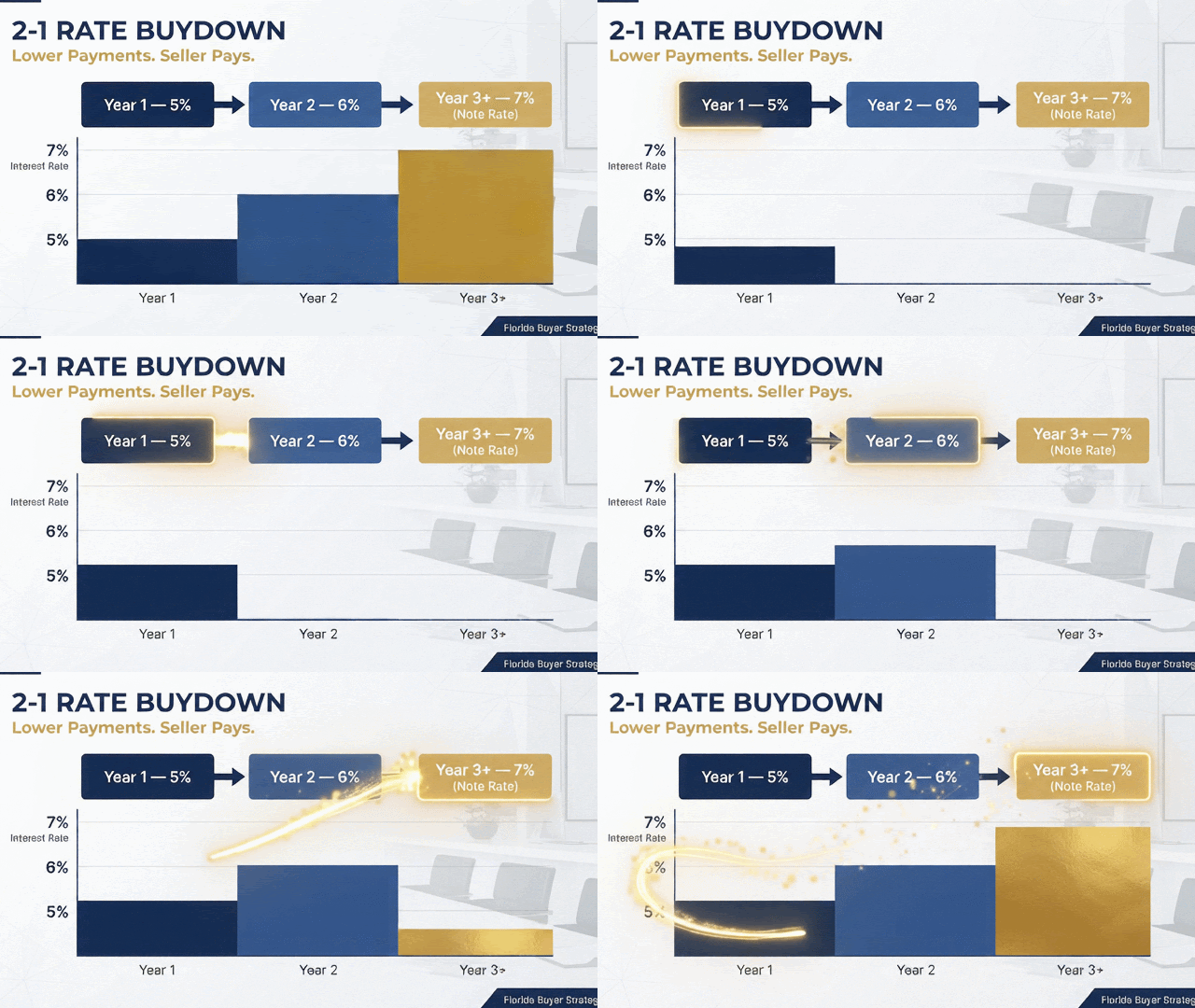
There is. It’s called a 2-1 rate buydown. It doesn’t lower your permanent rate. It doesn’t require rates to drop. What it does is reduce your effective payment for the first two years of your loan — by 2% in year one and 1% in year two — through a funded escrow account that makes up the difference each month. And in Florida’s current market, motivated sellers are increasingly willing to fund it as a negotiated concession.
How a 2-1 Buydown Works — Step by Step
Here’s the structure. Your note rate — the rate on your actual loan — stays the same. What changes is your effective payment in years one and two, funded by an escrow account established at closing.
Year 1
Note Rate − 2%
Lowest payments. Escrow covers the difference vs. full rate.
Year 2
Note Rate − 1%
Transition year. Escrow covers 1% gap vs. full rate.
Year 3 and Beyond
Full Note Rate
Payments settle at your permanent rate. Escrow is depleted.
The escrow account that funds the difference is deposited at closing — usually by the seller as a concession, but sometimes by the builder or lender. The total required equals the sum of all monthly payment shortfalls across the two reduced years.
Key distinction: A 2-1 buydown is a temporary rate reduction. It differs from buying permanent discount points, which lower the note rate itself for the life of the loan. With a 2-1 buydown, your note rate never changes — only the escrow-subsidized payment does. This means if you refinance before year three, the unused escrow balance may be credited back, unlike permanent points which are non-refundable.
2-1 Buydown Payment Calculator
See your year-by-year payments and the total buydown cost the seller would need to fund.
2-1 Buydown Payment Calculator
Enter your loan amount, note rate, and loan term. See year 1, year 2, and year 3+ payments — plus the total escrow cost.
Year 1 — Rate at —
—/month
Escrow pays: —/month | Year 1 escrow total: —
Year 2 — Rate at —
—/month
Escrow pays: —/month | Year 2 escrow total: —
Year 3 and Beyond — Full Note Rate at —
—/month
Your permanent payment for the remaining loan term
Total buydown escrow required (seller contribution needed)—
Principal and interest only. Estimates for illustration. Actual costs depend on lender, loan type, and other fees. Consult your lender for exact figures.
When a 2-1 Buydown Makes Sense — and When It Doesn’t
The 2-1 buydown is a strong choice when: you believe rates may decline within two to four years and you plan to refinance; you have adequate income to qualify for the note rate but want lower payments in the early years when moving costs and home expenses are highest; a motivated seller is willing to fund it as a concession; or you’re buying in a market where the monthly payment at the full rate is a stretch.
Permanent discount points may be a better choice when: you plan to hold the home for ten or more years without refinancing; rates are low relative to history; or you’re confident rates will not decline meaningfully and you want the guaranteed long-term savings of a permanently reduced rate.
The buydown doesn’t make sense if: you can’t qualify for the loan at the full note rate — the buydown doesn’t change qualifying income calculations, and lenders underwrite based on the note rate, not the reduced first-year rate. Confirm your qualification with your lender at the full rate before structuring a buydown offer.
Frequently Asked Questions — 2-1 Buydown in Florida
What is a 2-1 rate buydown? +
A 2-1 rate buydown is a temporary financing structure that reduces the borrower’s interest rate by 2% in year one and 1% in year two, then returns to the permanent note rate from year three onward. The difference between the reduced payment and the full payment is funded by a buydown escrow account — typically paid for by the seller or builder as a concession at closing.
How much does a 2-1 buydown cost in Florida? +
The cost equals the total monthly payment shortfall across both reduced years. For a $400,000 loan at 7%, the year-one savings at 5% are roughly $514/month ($6,168/year). Year two at 6% saves about $252/month ($3,024/year). Total buydown cost: approximately $9,192. This is deposited into the escrow account at closing and paid out monthly to subsidize your payment over the two years.
Can the seller pay for a 2-1 buydown in Florida? +
Yes. A seller-funded 2-1 buydown is one of the best uses of a seller concession in today’s market. The concession funds the buydown escrow at closing and counts toward the seller contribution limits by loan type (FHA allows up to 6% of purchase price, VA up to 4%, conventional 3–9% based on down payment). The strategy works especially well on homes where days-on-market are elevated and sellers want to offer meaningful incentives without reducing their list price.
What happens to the buydown escrow if I refinance or sell before year three? +
If you refinance or sell before the escrow is fully used, any remaining balance is applied as a credit — either to the loan balance on payoff, or potentially as a lender credit in a refinance. This flexibility is one of the key advantages of a temporary buydown over permanent discount points, which are non-refundable if you refinance early.
Is a 2-1 buydown better than permanently buying down the rate? +
It depends on your expected hold period and refinancing outlook. A permanent rate reduction is better if you plan to hold for 10+ years without refinancing. A 2-1 buydown is often better if you expect to refinance within 2–4 years — you get the payment relief now without locking into an illiquid points investment that loses value if you refinance early. In a market where many analysts expect rates to decline, the temporary structure often wins on flexibility.
Who else can pay for a 2-1 buydown besides the seller? +
Builders often fund 2-1 buydowns as a sales incentive, especially on spec homes or in communities with elevated inventory. Lenders can also fund them, though this typically increases costs elsewhere. Buyers can fund their own buydown — which may make sense if the payment relief justifies the upfront cost given their expected hold period. For most Florida buyers, the seller concession is the most common and cost-effective source.
Want to Know If a Buydown Makes Sense for Your Purchase?
I work on both sides — real estate and mortgage — so I can run the exact payment comparisons and help you structure the offer to get the seller to fund it. Let’s talk.