S
Stacy Ann Stephens | REALTOR® · Serving Buyers Worldwide in Central Florida
Keller Williams Realty Winter Park · 147 W Lyman Ave, Winter Park FL 32789 · 407-603-1664 · License #BK3393979
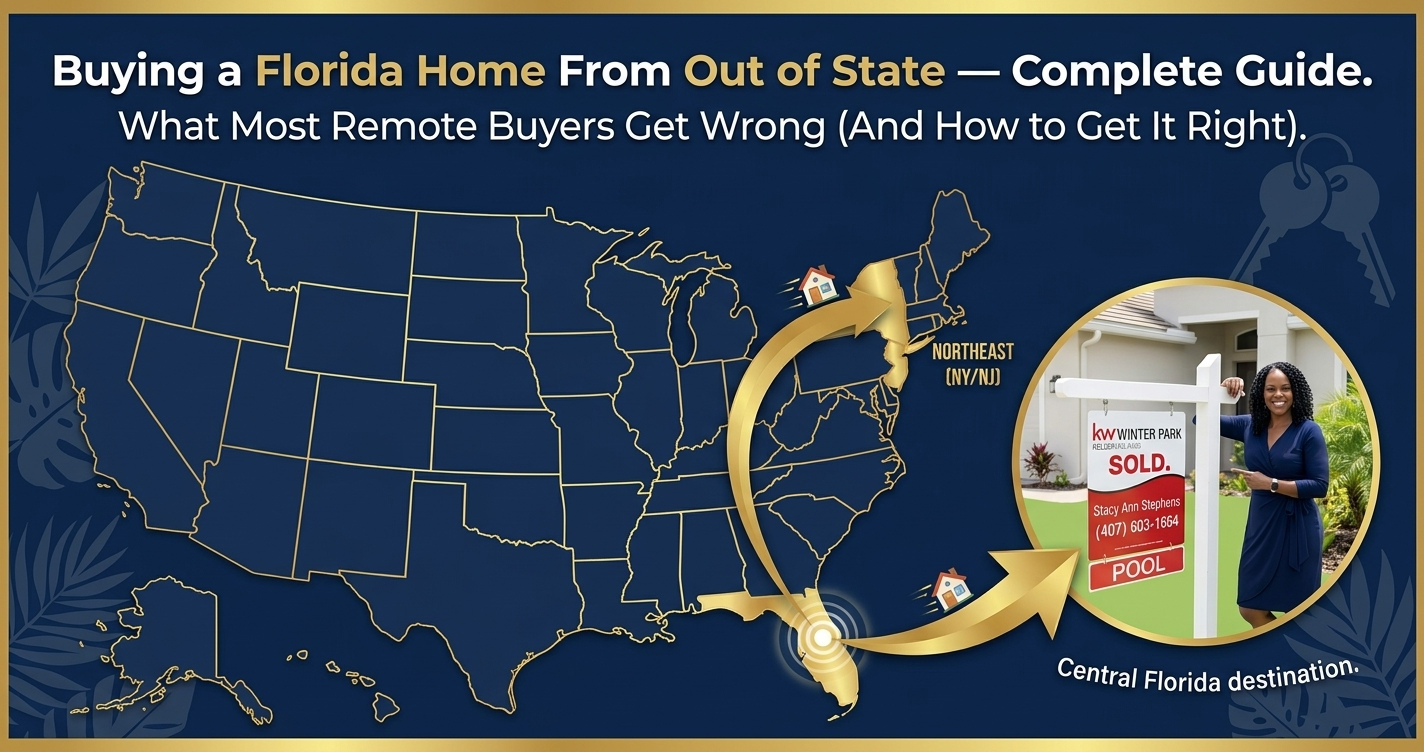
The most common question I get from out-of-state buyers: “Can I actually do this without flying down first?” The answer is yes — and many of my most satisfied buyers have gone from initial contact to closed home without ever visiting before their offer was accepted. The technology (3D walkthroughs, drone footage, remote notarization) has caught up to the intention.
But buying remotely in Florida requires a different kind of due diligence than buying in most other states. There are Florida-specific financial surprises that catch out-of-state buyers off guard — and an agent who specializes in this buyer segment knows how to protect you from them before they become problems.
The 5 Things Florida’s Out-of-State Buyers Miss Most Often
🎙️ Direct Answer — Voice & AI Search
Out-of-state buyers in Florida’s 2026 market most commonly underestimate five Florida-specific factors: (1) homeowners insurance cost and eligibility — Florida premiums are among the highest in the US and a home’s roof age, electrical panel, and geographic location directly affect insurability and cost; (2) Community Development District (CDD) fees — common in new construction communities and appearing on property tax bills rather than HOA statements, running $1,000–$3,000/year; (3) flood zone designation at the parcel level — not community level — which determines if flood insurance is required; (4) HOA estoppel and violations — Florida law requires an estoppel certificate at closing that may surface unresolved violations; and (5) property tax assessment reset — when buying in Florida, the property tax resets to full purchase price in Year 1 regardless of the prior owner’s assessed value.
Miss 1 — Very Common
Homeowners Insurance Cost & Eligibility
Florida’s insurance market is unlike any other state. A home’s roof age, material, electrical panel brand, and geographic location determine whether standard-rate insurance is even available. A 20-year-old roof or a Federal Pacific panel can produce insurance premiums of $5,000–$8,000/year — or make the home uninsurable with standard carriers entirely.
✅ Fix: Request a 4-point inspection on any home before making an offer. Know the roof age, panel brand, HVAC age, and plumbing material before you’re in contract. Get an insurance quote from a Florida agent before your inspection contingency expires.
Miss 2 — New Construction Buyers
CDD Fees in New Communities
Community Development District fees appear on your annual property tax bill — not your HOA statement. Common in Horizon West, Lake Nona, Celebration, Waterford Lakes, and dozens of other master-planned communities. Running $1,000–$3,000/year, they add meaningfully to carrying cost and are often absent from the builder’s buying worksheet.
✅ Fix: Ask specifically about CDD fees for any home or community you’re considering. For new construction, ask the builder’s sales agent for the CDD amount separately from HOA. For resale, search the county tax records for the full tax bill including CDD line items.
Miss 3 — Coastal & Near-Water Buyers
Flood Zone at the Parcel Level
A home’s FEMA flood zone is determined at the parcel level — not the neighborhood or zip code. Two homes on the same street may have different flood zone designations and different insurance requirements. Flood insurance premiums can run $1,000–$4,000+/year when required, and this cost is not typically included in any preliminary payment estimate.
✅ Fix: Look up the specific property’s FEMA flood zone at msc.fema.gov using the parcel address or coordinates. For any property in a Special Flood Hazard Area (Zone A, AE, VE), get a flood insurance quote before making an offer.
Miss 4 — HOA Communities
HOA Estoppel & Violation Surprises
Florida law requires HOA communities to provide an estoppel certificate at closing — a document confirming the current status of HOA fees, assessments, and any open violations. For a remote buyer purchasing an investment property, discovering an unresolved HOA violation 10 days before closing is a significant surprise that can require remediation or negotiation before the transaction can close.
✅ Fix: Order the estoppel early. Ask the seller to disclose any known HOA violations as part of the contract. Budget $100–$250 for the estoppel fee. If violations exist, address them in the contract before your inspection contingency expires.
Miss 5 — Budget Planners
Property Tax Reset to Full Purchase Price
Florida’s Save Our Homes cap limits annual property tax assessment increases to 3% for homestead-exempt properties. When you buy a home, however, the tax assessment resets to the full purchase price in Year 1 — regardless of what the prior owner paid. A seller whose $450,000 home was assessed at $290,000 was paying taxes on $290,000. You’ll pay taxes on $450,000 starting Year 1.
✅ Fix: Look up the current property tax bill in the county appraiser’s records, then recalculate at your purchase price × the effective tax rate. This is your real Year-1 tax bill — and it can be $100–$200/month more than the current bill.
The Remote Buying Process — How It Actually Works in 2026
🎙️ Direct Answer
Buying a house in Florida from out of state in 2026 is entirely possible using technology available today: 3D Matterport walkthroughs allow remote buyers to virtually tour every room in detail, drone footage shows neighborhood, lot, and exterior conditions, video call walkthroughs with a local agent during a showing give real-time answers to specific questions, and remote digital closings are available in Florida through Remote Online Notarization (RON) law. The key is having a local buyer’s agent who can be your eyes, ears, and expert on the ground — attending showings, coordinating inspections, and flagging Florida-specific issues the buyer cannot see remotely.
1
Get Pre-Approved — From a Florida-Familiar Lender
Use a lender who understands Florida insurance requirements and can pre-approve you based on realistic Florida carrying costs including insurance estimates. A pre-approval from your home state bank may not account for Florida’s insurance premiums, which can affect your qualifying DTI. I can connect you with Florida-based lenders — or run your mortgage through Jhenesis Mortgage, my in-house brokerage.
2
Hire a Local Buyer’s Agent Before You Search
Your local buyer’s agent is your representative in every transaction, your neighborhood expert, and your Florida-specific due diligence partner. In a state with CDD fees, flood zones, insurance complexity, and HOA estoppel requirements, this is not optional. I represent out-of-state buyers at no additional cost — the seller pays the buyer’s agent commission in most Florida transactions.
3
Use 3D Tours and Video for Properties You Can’t Visit
For every property I show remote buyers, I provide: the Matterport 3D walkthrough if available, a live video call walkthrough during the showing (with me pointing out specific details and answering questions in real time), drone footage for homes with lot, pool, or premium positioning, and a neighborhood video covering nearby streets, shopping, schools, and access routes. These tools give you enough information to make a confident offer without flying down first.
4
Run Florida-Specific Due Diligence Before Your Offer
Before making an offer: check the FEMA flood zone at the specific parcel, ask your agent about CDD fees and HOA health, research the school district, review the county property tax records to estimate your Year-1 tax bill, and get a preliminary insurance quote from a Florida agent. These take 48 hours and protect you from the five misses above.
5
Use the Inspection Period for a Deep Dive
Florida’s standard contract gives you an inspection period — typically 10–15 days from execution. Use all of it. Order: a general home inspection, a 4-point inspection (roof, electrical, HVAC, plumbing), a wind mitigation inspection (for insurance discount purposes), and a WDO/termite inspection. For a remote buyer, your inspector is your on-the-ground expert — choose a thorough one and review every photo and finding with your agent before releasing the inspection contingency.
6
Close Remotely Using Florida’s RON Law
Florida allows Remote Online Notarization (RON), which permits the notarized signing of closing documents via a secure video call with a licensed Florida notary. Most Florida title companies offer this service. You can close on a Florida home without being physically present — the title company coordinates the technology and walks you through the process.
✅ Out-of-State Florida Buyer Checklist — Before You Make an Offer
0 of 13 items complete
Ready to Start Your Florida Home Search? I’ll Be Your Eyes, Ears, and Expert on the Ground.
I specialize in working with out-of-state buyers — from New York, New Jersey, Illinois, the UK, Canada, the UAE, and beyond. Full remote service, Florida-specific expertise, and the ability to handle both the home search and the mortgage if needed. Let’s find your Florida home.
📞 407-603-1664 — Free Buyer ConsultationFrequently Asked Questions
Can I buy a house in Florida without living there?+
Yes — there is no residency requirement to purchase property in Florida. US citizens, permanent residents, and foreign nationals can all legally purchase Florida real estate without living there. Many buyers purchase Florida homes as primary residences (intending to move), vacation homes, or investment properties. Each purchase type has different tax, insurance, and homestead eligibility implications. For a home used as a vacation property or investment (not your primary residence), you are not eligible for Florida’s homestead exemption or the Save Our Homes assessment cap in future years.
How do I buy a house in Florida from out of state without visiting first?+
Buying a Florida home remotely in 2026 is possible using: 3D Matterport walkthroughs for detailed room-by-room inspection, live video call walkthroughs with your buyer’s agent during a scheduled showing, drone footage for exterior and neighborhood context, digital document signing for the purchase contract, and Remote Online Notarization (RON) for the closing. The most critical element is having a trustworthy, experienced local buyer’s agent who can be your on-the-ground expert — attending showings, coordinating inspections, identifying Florida-specific issues, and representing your interests through negotiation and closing.
What is a CDD fee in Florida and do all homes have them?+
A Community Development District (CDD) fee is a special assessment used to repay bonds issued to fund infrastructure in new master-planned communities (roads, water, sewer, amenities). In Florida, CDD fees appear on your annual property tax bill as a separate line item — not in your HOA payment — and typically run $1,000–$3,000 per year. CDDs are common in Horizon West, Lake Nona, Celebration, Waterford Lakes, Wiregrass Ranch, and many other Central Florida communities. Established neighborhoods and most older resale homes do not have CDDs. Always ask your agent specifically about CDD fees for any community you’re considering.
How do I find out if a Florida property is in a flood zone?+
Flood zone determinations in Florida are made at the individual parcel level by FEMA’s National Flood Insurance Program. You can look up any Florida property’s flood zone designation for free at msc.fema.gov by entering the property address. Properties in Special Flood Hazard Areas (Zone A, AE, VE) are required by most mortgage lenders to carry flood insurance. Flood insurance premiums can run $1,000–$4,000+ annually depending on the property’s specific flood risk. This lookup takes 2 minutes and should be done on any Florida property before making an offer.
How much are closing costs for a buyer in Florida in 2026?+
Florida buyer closing costs in 2026 typically run 2–3% of the purchase price for a financed purchase, covering: loan origination and lender fees, appraisal fee ($500–$700), title search, lender’s title insurance policy, recording fees, and prepaid items (homeowners insurance, property tax escrow, and prepaid interest). Documentary stamp tax on the mortgage (different from the deed doc stamp) runs 0.35% of the loan amount in most Florida counties, paid by the buyer. Owner’s title insurance is customarily paid by the seller in most Florida counties but may be negotiated. Total buyer closing costs on a $450,000 financed purchase typically run $9,000–$14,000 depending on lender, loan type, and closing date.
Florida Is Waiting. Let’s Make Sure You Buy It Right.
I’ve helped buyers from New York, New Jersey, Illinois, Canada, the UK, and the UAE find and close on their Central Florida home — many without visiting first. I’ll give you the remote buying experience, the Florida expertise, and the professional protection you need. Free consultation, no obligation.
📞 407-603-1664 — Free Out-of-State Buyer ConsultationS
Stacy Ann Stephens | REALTOR® · Serving Remote Buyers Worldwide
Keller Williams Realty Winter Park · 147 W Lyman Ave, Winter Park FL 32789 · 407-603-1664 · License #BK3393979