
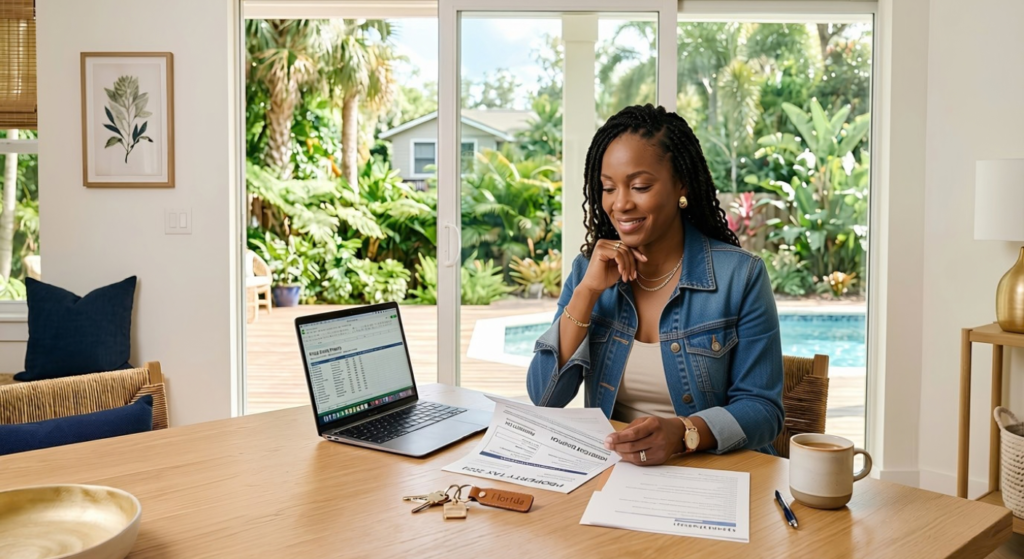
Florida Property Tax Guide · Central Florida
Your Portability Benefit
Could Be Worth Thousands.
Don’t Lose It.
Most Florida homeowners leave their Save Our Homes tax savings behind when they move — not because the benefit disappears, but because nobody told them how to bring it with them. Here’s exactly how portability works, what you can transfer, and how to file in Orange, Seminole, Osceola, and Lake counties.
What Is Florida Homestead Portability?
If you’ve owned your Florida home for more than a few years, your taxable value is probably much lower than what your home is worth. That gap is your Save Our Homes benefit — and you can take it with you.
Florida’s Save Our Homes (SOH) law caps how fast your home’s assessed value can grow — no more than 3% per year (or the Consumer Price Index, whichever is lower). After a decade of ownership in a rising market, that cap can represent tens — or even hundreds — of thousands of dollars in tax savings each year.
Portability lets you transfer that accumulated benefit to your next Florida home. Without it, when you sell and buy again, your new home is reassessed at full market value and your taxes reset to zero savings. With portability, you bring your old benefit with you, reducing your new home’s assessed value from day one.
The Save Our Homes Cap
After you apply for homestead exemption, your assessed value can only rise up to 3% annually — even in a hot market. Over years, this creates a large gap between market value and taxable value.
The Portability Transfer
When you sell and buy a new Florida primary home, you can transfer that gap — up to $500,000 — to your new home’s assessed value. File Form DR-501T with your new county by March 1.
The Real Dollar Impact
Transferring $200,000 in SOH savings at an effective tax rate of 1.5% means you save roughly $3,000 per year — every year — until you sell again. That’s real money on your monthly payment.
How Your Portability Benefit Is Calculated
The formula depends on whether you’re upsizing or downsizing. Your county property appraiser makes the final determination, but here’s exactly how it works:
📐 The Portability Formula
Your SOH Adjustment = Just (Market) Value minus Assessed Value on your old tax bill
Scenario A: You’re Upsizing (New Home ≥ Old Home Value)
Scenario B: You’re Downsizing (New Home < Old Home Value)
💡 Buyer’s Tax Reset Warning
Even with portability, your first tax bill will likely be higher than the seller’s. Why? The county reassesses to full market value at closing. Portability reduces that starting point, but won’t match a seller’s decades-old capped rate. Always ask for a projected tax estimate — not just the seller’s current bill — before you close.
How to File for Portability: Step-by-Step
Filing is straightforward if you know what to submit and when. Miss the March 1 deadline and you wait another full year.
Find Your Previous SOH Adjustment
Pull your last tax bill from your previous county. Look for “Just Value” and “Assessed Value.” The difference is your SOH adjustment. If you no longer have the bill, contact your previous county’s property appraiser — they can provide a portability letter showing the exact amount.
Download Form DR-501T
Get the Transfer of Homestead Assessment Difference form (DR-501T) from the Florida Department of Revenue at floridarevenue.com or from your new county’s property appraiser site. Have your prior tax bill, closing paperwork, and government-issued ID ready.
Apply for Your New Homestead Exemption (Form DR-501)
Portability can only be claimed on a property that qualifies for homestead exemption. File Form DR-501 at the same time as your DR-501T. You must be a Florida resident, own the property, and use it as your primary residence as of January 1 of the filing year.
Submit to Your NEW County’s Property Appraiser by March 1
Both forms go to your new county — not where you came from. Most Central Florida counties accept online submissions, email, mail, or in-person filing. See the county-specific section below for exact contacts and links.
Confirm and Track Your Application
After filing, your new county’s property appraiser reviews both filings and calculates the final portable amount. Processing can take several months. You’ll receive written notification of the final assessment — keep this for your records and verify it matches your expectation.
| Situation | Portability Available? | Notes |
|---|---|---|
| Moving within Florida (any county) | ✓ Yes | Works across all 67 Florida counties |
| Moving from Florida to another state | ✗ No | SOH benefit cannot leave Florida |
| Moving back to Florida after living out of state | ✗ No | Prior FL benefit is gone; start fresh |
| Investment property → new primary residence | ✗ No | SOH/portability only for homestead properties |
| Inherited homestead property | ✓ Partial | Varies; consult county appraiser |
| Divorce — one spouse keeps the home | ✓ Yes | Court decree may specify division of benefit |
| Within 3-year window of abandoning old homestead | ✓ Yes | Must file DR-501T by March 1 |
| After 3-year window has passed | ✗ No | Benefit permanently forfeited |
Central Florida County-by-County Filing Guide
The process is the same everywhere, but each county has its own office, online portal, and contact. Here’s where to go.
Orange County
Orange County Property Appraiser
Seminole County
Seminole County Property Appraiser
Osceola County
Osceola County Property Appraiser
Lake County
Lake County Property Appraiser
Volusia County
Volusia County Property Appraiser
Brevard County
Brevard County Property Appraiser
📋 Moving from Outside Central Florida?
Portability works from any of Florida’s 67 counties. Contact your previous county’s property appraiser and request a “portability letter” showing your SOH adjustment amount. Bring this with you when you file in your new county.
5 Portability Mistakes That Cost Homeowners Thousands
These are the most common — and most expensive — errors I see Central Florida homeowners make:
Missing the 3-Year Deadline
The clock starts January 1 of the year you abandoned your homestead — not your closing date. Homeowners who take a year off between selling and buying often assume they have time. Check your calendar carefully. Once the window closes, there is no exception.
Filing Only the Homestead Application (Forgetting DR-501T)
Getting your homestead exemption on the new home is not enough. You must also file Form DR-501T specifically to claim portability. Many homeowners file DR-501 and never know portability exists — or assume it happens automatically. It doesn’t.
Filing With the Wrong County
Portability forms go to your new county’s property appraiser, not your old one. The old county keeps records of your prior homestead, but the application process belongs to where you’re moving to. This mix-up causes missed deadlines every year.
Accepting the Seller’s Tax Bill as Your Future Tax Bill
A seller paying $3,200/year in property taxes doesn’t mean you will. That rate is based on their assessed value, which may be capped far below market value. Your taxes reset at purchase. Even with portability, always run a current projection — your lender needs this for an accurate debt-to-income calculation too.
Renting Out the Property Before Filing
Homestead exemption (and therefore portability) requires the property to be your primary residence as of January 1. If you close in November, move in, then rent the property out before January 1, you may not qualify for that year. Timing your closing and occupancy matters.
Florida Portability FAQs
The questions I get from clients almost every week — answered straight.
What is the difference between homestead exemption and portability?
Homestead exemption reduces your property’s taxable value by $50,000 (the first $25,000 applies to all taxes; the second $25,000 applies to non-school taxes) and kicks in the year after you purchase. Portability is a separate benefit that lets you carry your accumulated Save Our Homes assessment cap reduction from your old home to your new one. You need homestead exemption to qualify for portability — but they are two different applications and two different forms.
Can I use portability if I’m buying a condo?
Yes. Condos qualify for homestead exemption and portability in Florida just like single-family homes, as long as the condo is your primary residence. The same rules, deadlines, and forms apply.
My home has been in my family for years. Do I inherit the portability?
Inherited properties are a gray area. Generally, you cannot inherit the previous owner’s SOH benefit directly — the Save Our Homes cap is tied to the individual who applied for homestead. However, if you inherit and occupy the property as your primary residence and establish your own homestead exemption, you start building your own SOH cap from that point forward. Some limited exceptions exist for surviving spouses. Consult your county property appraiser for your specific situation.
What happens to portability if I move out of Florida temporarily?
If you establish a homestead in another state — even temporarily — you generally cannot reclaim Florida portability when you return. Once you break Florida homestead residency, the SOH clock and portability benefit are typically gone. Retirees who “snowbird” in another state but maintain Florida as their primary legal domicile (one primary homestead total) are usually safe, but you should confirm with your county property appraiser if your situation is nuanced.
Can I transfer portability to a new home I’m building?
Yes, portability can be applied to new construction. The key is timing: you must establish your homestead exemption on the new construction by March 1, which requires the home to be substantially complete and occupied as your primary residence as of January 1 of the filing year. Delays in construction can affect your ability to file on time.
What if my previous county’s portability letter shows a different amount than I expected?
You can request a formal review or appeal through the property appraiser’s office. If you believe there’s an error, provide your prior tax bills as documentation. County property appraisers are generally helpful in working through these calculations — give them a call before your filing deadline rather than after.
Does the 2026 Florida legislature change portability rules?
Three ballot measures are pending for November 2026 that could expand portability benefits if approved by 60% of Florida voters (effective 2027). One would remove the current $500,000 cap on transferable benefits, another would reduce the annual SOH cap from 3% to 1.5%, and a third would shift reassessment to a three-year cycle. None of these eliminates portability — they would make it more generous. Current rules and deadlines remain in effect through at least the end of 2026.
I’m an investor — can I get portability on my rental properties?
No. Save Our Homes and portability apply only to your primary homestead residence. Investment properties, second homes, and rental properties are not eligible and are reassessed at market value each year. This is one reason why investors buy differently than owner-occupants — property tax projections for investment properties must always be based on current market value, not the seller’s tax bill.
Your Guide Through This
I Help Central Florida Homeowners Protect Their Savings When They Move
Most people find out about portability from a friend — or from the shock of their first tax bill in a new home. I make sure my clients know before they close, not after.
As a licensed Florida Real Estate Broker affiliated with Keller Williams Realty Winter Park, I work with move-up buyers, downsizers, and first-time homeowners across Central Florida. Portability is one of those topics that sounds complicated but becomes simple once you understand the moving pieces.
If you’re thinking about selling, buying, or both — let’s run your portability numbers together before you make any decisions. It’s free, it takes 15 minutes, and it could easily save you $2,000+ a year in property taxes.
Let’s Talk PortabilityWhat You Get When We Connect
- ✓ Your estimated SOH adjustment calculation
- ✓ Projected property taxes on any home you’re considering
- ✓ Personalized portability transfer scenario
- ✓ County-specific filing checklist
- ✓ No pressure, no obligation
Free Portability Review
Find Out Exactly What Your SOH Benefit Is Worth
Tell me a bit about your situation and I’ll reach out with a custom portability estimate — usually within one business day.