
Buying New Construction
Is a Process. Here’s Every Step.
From choosing a lot to picking up your keys — the full 13-phase lifecycle, the way builders and lenders actually run it in Orange, Osceola, and Lake County.
Most buyers think new construction is easy — find the community, sign the contract, move in. The reality is far more layered, and the mistakes buyers make at Phase 3 can cost them $40,000 at Phase 12. I’ve watched this process play out hundreds of times across Central Florida. This guide gives you the full picture — no sugar-coating, no builder spin.
The Full Lifecycle
From Dirt to Deed: All 13 Phases
Whether you’re buying in Horizon West, Storey Lake, Laureate Park, or one of the dozens of communities rising across Orange and Osceola County — this is how the process actually works.
Community & Builder Selection
You’re not just choosing a house — you’re choosing a builder, a community, and a future neighborhood. In Central Florida, where active adult communities, STR-eligible developments, and family subdivisions all sit within 10 miles of each other, this decision shapes everything that follows.
- Builder reputation: Research warranty track record, BBB ratings, and Florida contractor license history (DBPR.com). DR Horton, Pulte, Toll Brothers, Meritage, and Dream Finders each have different quality tiers and customer service cultures.
- Inventory vs. to-be-built: Move-in-ready spec homes close faster but offer no customization. “Dirt” contracts let you select everything — but you’re signing on a 10-month timeline.
- Future development: Request the full master plan. That empty field behind the community may be zoned for a distribution center.
- HOA & CDD fees: Central Florida has many Community Development Districts — CDD fees are separate from HOA and can add $1,500–$3,500/year to your carrying cost.
- Tax rates by county: Orange County, Osceola County, Lake County, and Polk County all have different millage rates. A $450K home in Osceola may cost $800/year more in taxes than the same home in Lake County.
Trusted Insider: Visit the community on a weekday and a weekend — at different times. Talk to existing homeowners, not just the sales rep. Ask specifically: “Have there been any drainage issues?” and “What’s the construction noise/dust schedule?”
Lot (Homesite) Selection
This is one of the most underestimated decisions in new construction — and one of the most consequential for resale value. In Florida, lot premiums aren’t cosmetic. They reflect real differences in livability, flood exposure, and marketability.
- Lot premiums: Water views can add $10,000–$40,000 to the base price. Corner lots, cul-de-sacs, and conservation lots also carry premiums — but they tend to hold value better.
- Sun orientation: South-facing rear yards get the most sun — important for pool enjoyment and energy efficiency in Florida’s climate. West-facing rear yards mean afternoon heat on your lanai year-round.
- Drainage & elevation: Florida is flat. Ask for the grading plan and FEMA flood zone designation. Is the lot in AE, AH, or X? This determines whether flood insurance is required — and at what cost.
- Proximity to amenities vs. noise: The home closest to the playground or amenity center sounds great — until Saturday morning.
- Power lines, easements, and utility boxes: These never show up in renderings. Walk the lot and look for easements that limit fence placement or additions.
Trusted Insider: The lot premium you pay upfront often comes back in resale. A $20K pond-view premium on a $450K home frequently translates to a $35K–$50K price advantage at resale. Standard interior lots are harder to differentiate.
Floor Plan & Structural Options
Pick your model — then decide on any structural changes. This is the only phase where you can fundamentally alter the architecture of the home. Once walls are framed, nothing structural can be changed.
- Single-story vs. two-story: Two-story homes are generally more affordable per square foot. But in Florida, single-story is significantly easier to sell — especially to retirees, snowbirds, and aging-in-place buyers. It matters for resale.
- Structural upgrades to consider: Extended lanai/covered patio, bedroom in lieu of study, bonus room over garage, 3-car garage conversion, 10′ vs 9′ ceilings, extended owner’s suite, bay window additions.
- What you cannot change later: Number of bedrooms, ceiling heights, garage size, structural walls, room layout. Everything else at the Design Center is cosmetic.
- Budget reality check: Structural upgrades are expensive at the builder level — but often cheaper than renovating post-close, because they’re built-in vs. retrofit.
Don’t skip this step thinking “I’ll renovate later.” Adding a bedroom over the garage post-close typically costs 3–5x what the builder charges. Structural decisions must happen now.
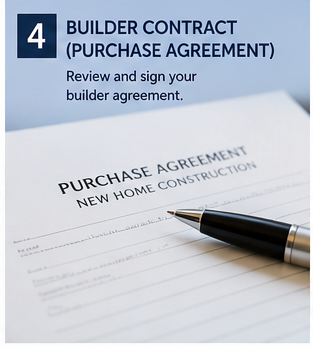
The Builder Contract (Purchase Agreement)
This is not the standard FAR/BAR contract you see in resale. Builders use their own contracts — written by their attorneys, to protect their interests. That doesn’t mean you’re unprotected, but it does mean you need to read every word, and ideally have a real estate attorney review it before you sign.
- Estimated completion date: Builders give a range, not a date. “Estimated Q3 2025” can become Q1 2026 due to supply chain, permit delays, or labor shortages. The contract protects the builder’s timeline — not yours.
- Earnest money deposit: New construction deposits typically run 3–5% of the purchase price — often $10,000–$25,000 or more. Unlike resale, much of this is non-refundable after a certain point.
- Price escalation clauses: Some builders include clauses allowing them to increase the price if material costs rise. Know what you’re agreeing to.
- Financing contingency language: Builders’ contracts often have limited or no financing contingency. If you can’t close, you may forfeit your deposit.
- Inspection rights: Not always guaranteed in builder contracts. Ensure your right to a pre-drywall and final inspection is explicitly stated.
Builders employ on-site sales reps — not neutral parties. Having your own buyer’s agent at no cost to you means someone is reading that contract on your behalf. Having an attorney review it is money well spent.
Trusted Insider: I’ve seen buyers lose $15,000–$25,000 in deposits because they didn’t understand the cancellation terms in a builder contract. These are not the same as resale contracts. Ever.
Financing Pre-Approval & Lender Choice
This phase is where I have to be direct with you: the builder’s preferred lender is not necessarily the right lender for you. They offer incentives — closing cost credits, rate buydowns, free upgrades — to steer your loan to their preferred partner. Sometimes those incentives make sense. Often they don’t.
- Builder incentives: Builders may offer $5,000–$20,000 in closing cost credits IF you use their lender. Always compare the net rate and total cost — a slightly worse rate over 30 years can cost more than that incentive.
- Pre-approval must be solid: In a new construction contract, you typically have 14–21 days to provide a pre-approval letter. Credit, income, and assets need to be verified and clean before you sign.
- Non-QM / alternative income buyers: If you’re self-employed, an ITIN holder, or qualifying through bank statements or DSCR — you need a lender who specializes in non-QM loans. Most builder-preferred lenders work in conventional only.
- Foreign national buyers: If you’re not a U.S. citizen or permanent resident, you need a lender with a foreign national loan program — not the builder’s in-house lender.
Whether you’re W-2, self-employed, an ITIN holder, or an international buyer — I’ll run your numbers and compare your total cost across lenders, including the builder’s. You deserve the full picture before you commit. Get pre-approved at JhenesisMortgage.com →

Design Center / Selections Appointment
This is the phase where buyers spend tens of thousands of dollars they didn’t plan on spending. The design center is beautiful, professionally staged, and expertly staffed. Bring a budget and a firm hand.
- What you’re selecting: Cabinets, countertops (quartz vs. granite vs. laminate), flooring type and color, backsplash, fixtures, hardware, tile selections, appliance packages, electrical upgrades (extra outlets, USB ports, under-cabinet lighting, smart home wiring).
- Typical upgrade spend in Central FL: $15,000–$60,000 above the base price is common. Some buyers spend over $100K in upgrades on larger homes.
- What’s worth it: Flooring, countertops, and electrical — because they’re expensive and disruptive to change later. Paint colors and fixtures can be swapped affordably post-close.
- Non-refundable design deposit: Builders typically require a design deposit (often $2,000–$5,000) to hold your selections. This is usually separate from your initial earnest money.
- ROI perspective: Not every upgrade adds equal resale value. Kitchen and primary bath upgrades recoup more than bedroom flooring. Ask me what buyers actually pay for in your target neighborhood.
Trusted Insider: I tell every buyer: max out electrical and structural at the Design Center. Save on paint. You can always repaint. You cannot affordably add outlets or move a wall.
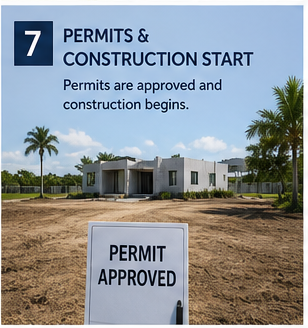
Permits & Construction Start
Once contracts are signed, deposits paid, and selections finalized — the builder applies for permits and construction officially begins. This is where your patience muscle gets tested.
- Permit timing: In Orange and Osceola County, permits for residential construction typically take 4–10 weeks. Some counties are faster; some are slower depending on backlog.
- Timeline expectations: A single-family home in Central Florida typically takes 5–9 months from permit to CO (Certificate of Occupancy). Larger, more complex homes can run 10–14 months.
- Weather delays: Florida’s rainy season (June–September) can cause meaningful delays — especially for site work and concrete pours. Build this into your expectations.
- Your lender’s job at this phase: Stay in contact. Update any financial documents that may expire (pay stubs, bank statements) before closing gets near.
Florida Tip: You can track your permit status in real-time through Orange County’s online portal (Accela Citizen Access) or your builder’s customer portal. Don’t rely solely on sales rep updates.
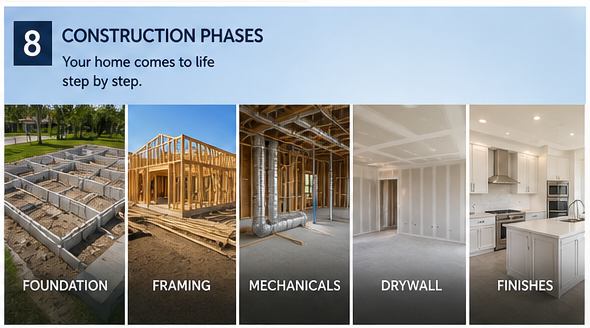
Construction Phases & Milestone Walkthroughs
Once construction begins, most reputable builders provide milestone updates — and some allow walkthrough access at key stages. Understanding these phases helps you know when to ask questions.
- Site prep & foundation: Land is cleared, graded, and slab is poured. This is when you’ll see the actual footprint of your home for the first time.
- Framing: Walls, floor joists, and roof trusses go up. This is typically the most visually dramatic phase — the home takes shape quickly.
- Mechanicals (rough-in): Plumbing pipes, electrical wiring, and HVAC ductwork are installed inside the walls before drywall goes up. This is the most important phase to inspect.
- Drywall & finishes: Walls are closed up, flooring goes down, cabinets and counters are installed. The home starts looking like a home.
- Punch list & final prep: Paint touch-ups, fixtures installed, cleaning — the home is prepared for final inspection and closing.
Trusted Insider: Some builders restrict buyer access during construction for liability reasons — but most allow scheduled visits at major milestones. Always bring a camera and document everything. What you see during framing is what gets closed into your walls.
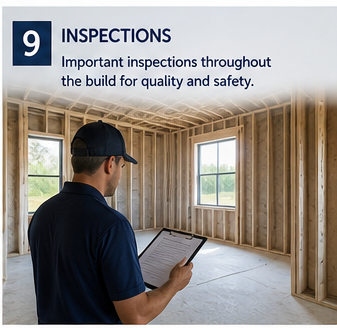
Independent Inspections — Yes, Even for New Construction
One of the most common myths in new construction: “It passed city inspection, so it must be fine.” City inspectors are overworked, often inspecting dozens of homes per day, and checking for code compliance — not quality or craftsmanship. You need your own inspector.
- Pre-drywall inspection: The single most important inspection in new construction. A qualified inspector can see wiring, plumbing, and HVAC before it’s sealed inside the walls. Issues caught here are cheap to fix. Discovered post-close, they’re not.
- Final inspection (before closing): A full walk of the completed home. Document every cosmetic and mechanical issue in writing before you hand over a dollar.
- What to look for: Improperly tied HVAC ducts, missing insulation bays, improper grade drainage (water running toward the house), reversed electrical outlets, inadequate attic ventilation, stucco cracks, window seals.
- Cost: Expect to pay $400–$700 for a pre-drywall + final inspection combo in Central Florida. It is worth every dollar.
I have clients who closed on brand-new homes in the Orlando area and discovered major plumbing misroutes, unsealed roof penetrations, and HVAC ductwork that was never properly connected — all of which passed city inspection. Independent inspectors catch what code inspectors don’t have time to find. This is non-negotiable in my clients’ transactions.
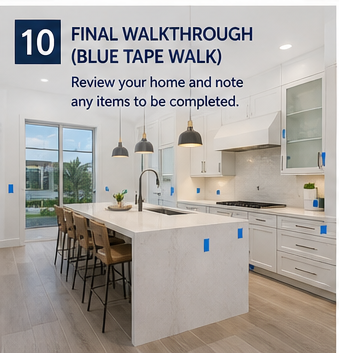
Final Walkthrough — The Blue Tape Walk
This is your last opportunity to document cosmetic issues before title transfers. You and the builder’s construction manager walk every room, every surface, every system — and anything that needs attention gets flagged with blue painter’s tape or documented on a list.
- What to flag: Paint imperfections, drywall dings, scratched flooring, caulk gaps, missing hardware, uneven grout lines, windows that don’t lock properly, doors that don’t latch cleanly.
- What to test: Run every faucet, flush every toilet, test every outlet with a plug-in tester, run all appliances, check every door and window, run the HVAC, test the garage door openers.
- Get it in writing: Every item on the punch list should be documented in writing with a signature from the builder’s rep. Verbal agreements don’t hold up after closing.
- Timeline for repairs: Builders typically have 30–45 days post-close to complete punch list items. Understand this before you close.
Trusted Insider: Don’t let excitement rush you through this walkthrough. This is a transaction worth hundreds of thousands of dollars. Take 2–3 hours. Bring a flashlight, a phone charger (to test outlets), and your inspection report.
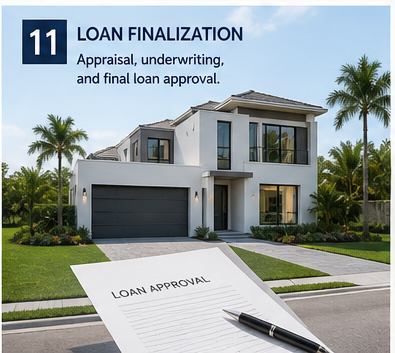
Appraisal, Underwriting & Rate Lock
As construction wraps up, your lender shifts into active mode. This is one of the most time-sensitive phases — and where having a proactive lender (not one that needs you to chase them) makes a real difference.
- Appraisal: The lender orders an appraisal of the completed home. Unlike resale, the appraiser is evaluating a property with no sales history, using recently sold comps in the community and surrounding area.
- Appraisal gap risk: In communities with high upgrade costs, the appraised value can come in below the contracted purchase price. If you’ve spent $40K at the Design Center, not all of that may appraise. Know your exposure before closing.
- Final underwriting: Income, assets, and credit are re-verified. Do not open new credit accounts, change jobs, or make large purchases between contract signing and closing.
- Rate lock — the critical decision: Locking a rate 8–10 months out costs more than locking 30–45 days before closing. But floating the rate carries market risk. See the rate strategy section below.
Extended rate lock programs, float-down options, and new construction loan structures are my specialty. I’ll map your timeline to the right lock strategy so you don’t get caught with an expired rate lock 30 days before closing. Talk through your options →
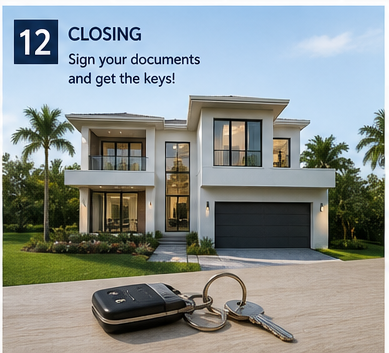
Closing Day
Closing on a new construction home follows the same general structure as a resale transaction — but the timing works differently. Builders often push for a specific closing date based on their fiscal calendar, end of quarter, or construction schedule. Be prepared for that date to move.
- What you’re signing: Loan documents (mortgage, promissory note), title transfer documents, property disclosures, HOA/CDD acknowledgments, builder’s warranty documentation.
- Closing costs: Expect 2–4% of the loan amount in closing costs. If you’re using the builder’s lender with an incentive package, review the Loan Estimate carefully — sometimes the “credit” is offset by a higher rate.
- Title company: Builders typically have a preferred title company. In Florida, you have the right to choose your own title company. The party paying for owner’s title insurance usually has the right to select.
- Final walk before you sign: If punch list items from Phase 10 haven’t been completed, confirm whether you’re closing on a builder’s promise or a completed list. Get guarantees in writing before signing.
Trusted Insider: Builder-preferred title companies are not necessarily bad — but confirm your title commitment shows no liens, no open permits, and a clear chain of title before closing day. Your agent should be reviewing this with you.
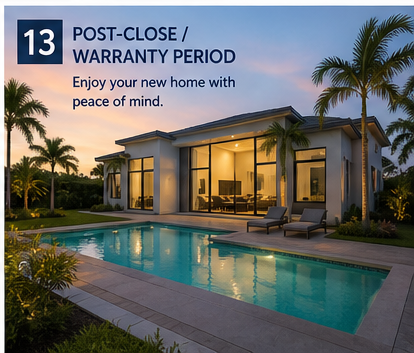
Post-Close: Warranty Period & Punch List
New construction doesn’t end at closing. The warranty period is a real benefit — and a real responsibility. Know what you’re covered for and when to make claims.
- 1-year workmanship warranty: Covers defects in materials and workmanship — paint, drywall, fixtures, flooring. This is the most common warranty used in the first year of ownership.
- 2-year systems warranty: Covers mechanical systems — plumbing, electrical, HVAC. In Florida’s heat and humidity, this matters. Report HVAC issues during this window, not after.
- 10-year structural warranty: Covers major structural defects — foundation, load-bearing walls, roof framing. Florida’s soil conditions and settlement patterns make this valuable.
- The 11-month inspection: Industry professionals recommend scheduling a professional inspection around month 11 — while you’re still under the 1-year workmanship warranty. Document everything before it expires.
- Ongoing punch list: It’s normal for a new home to reveal minor issues in the first 90 days of occupancy — settlement cracks in drywall, doors that need adjusting, grout hairlines. Document and report on schedule.
Trusted Insider: Put a recurring calendar reminder for month 10 of homeownership: “Schedule 11-month inspection.” This one habit has saved my clients thousands by catching warranty items before they expire. Most buyers forget entirely and call me at month 14 when nothing is covered.
Who’s Building in Central Florida
Active Builders & Communities to Know
These are the builders currently active across Orange, Osceola, Lake, and Polk Counties. Each has different quality levels, contract terms, and lender incentive structures.
Financing Intelligence
New Construction Rate Lock Strategy
This is one of the most overlooked differences between buying resale and buying new construction. In a resale deal, you lock your rate 30–45 days before closing. In new construction, you may be 8–12 months away. Your lock strategy matters.
You don’t lock until construction is near complete — typically 30–60 days before closing. You benefit if rates drop during the build period. You’re exposed if rates rise.
- No extended lock fee
- Benefits from rate drops
- Works in declining rate environments
- Higher risk if market moves against you
Lock your rate for 9–12 months. If rates drop by a certain percentage before closing, you can “float down” to the lower rate. Costs a fee (typically 0.25–0.75% of the loan amount) but provides certainty.
- Rate certainty during long build
- Float-down option captures drops
- Preferred by builders who close on schedule
- Fee may be offset by builder incentives
I’ll model both scenarios based on your loan amount, builder timeline, and current market so you can make an informed choice — not a guess. Available for conventional, FHA, VA, DSCR, and non-QM. Start the conversation →
Know the Difference
New Construction vs. Resale: What Actually Changes
Most buyers have bought resale before. New construction has a completely different set of rules — and the surprises usually cost money.
| Factor | Resale | New Construction |
|---|---|---|
| Contract Type | Standard FAR/BAR — balanced for both parties | Builder’s proprietary contract — written for the builder |
| Inspection Timing | One inspection, typically within 15 days of contract | Pre-drywall + final — months apart during construction |
| Rate Lock Window | 30–45 days before closing | 6–12 months; extended lock programs required |
| Price Flexibility | Negotiable with seller; concessions common | Base price rarely moves; incentives via upgrades or credits |
| Appraisal Risk | Comparable sales usually available in the area | Limited comps; Design Center upgrades may not appraise |
| Earnest Money | Typically 1–3%, mostly refundable | 3–5%+, often non-refundable after specified periods |
| Timeline Certainty | 30–45 days once under contract | Estimated range; delays of 2–4 months are common |
| Post-Close Warranty | Generally none (as-is or negotiated) | 1-yr workmanship / 2-yr systems / 10-yr structural |
| Buyer’s Agent Cost | Seller typically pays buyer’s agent commission | Builder typically pays; confirm before entering sales office |
| Customization | What’s there is what you get | Full structural and finish customization (if to-be-built) |
Common Questions
New Construction in Central FL — Your Questions Answered
Do I need a real estate agent to buy new construction in Florida?
Can I use an ITIN or be a foreign national and still buy new construction in Florida?
What happens if my home isn’t finished by the time my rate lock expires?
How much should I budget for Design Center upgrades?
What is a CDD fee and do all new construction homes in Central Florida have them?
Can I back out of a new construction contract in Florida?
One Agent. One Lender. Zero Surprises.
I’m both your Realtor and your Mortgage Broker. That means your home search and your loan strategy stay aligned — from lot selection through closing day.
Ready to tour new construction communities in Central Florida? I’ll guide you through the builder landscape — with no builder bias.
Work with StacyW-2, self-employed, ITIN, or foreign national — I’ll find the right program for your situation before you sign a builder contract.
Apply at Jhenesis Mortgage