
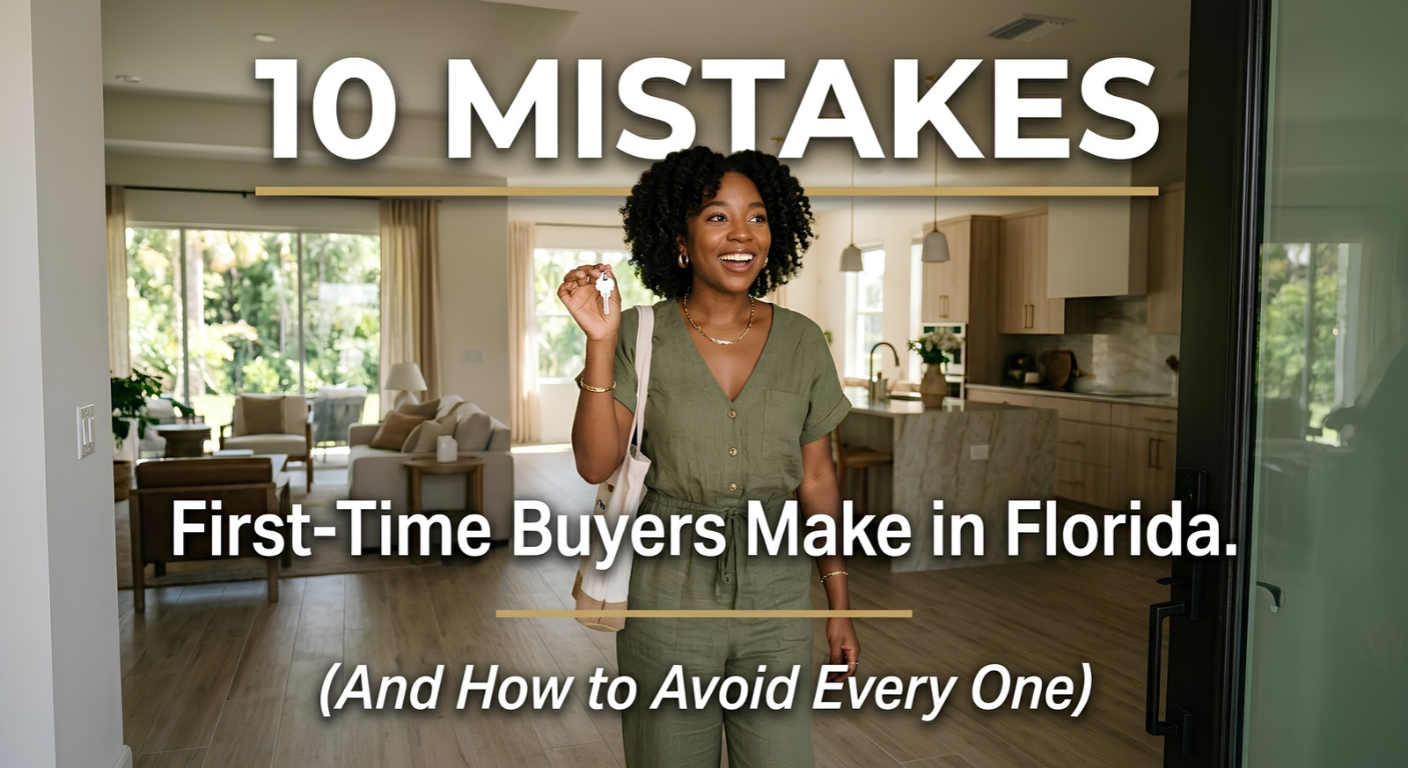
First-Time Home Buyer Mistakes in Florida 2026 (And How to Avoid Every One)

First-Time Home Buyer Mistakes in Florida 2026 — And How to Avoid Every One

After 24 years helping Florida buyers close, these are the 10 mistakes I see most often — and the ones that quietly cost the most money, time, and sleep. Knowing them before you start changes everything.

Buying your first home in Florida is genuinely exciting. It’s also one of the biggest financial decisions most people will make in their lives — and the process is more complicated than most first-time buyers expect. Florida has its own quirks: higher-than-average homeowners insurance, documentary stamp taxes, condo laws that changed significantly in recent years, and a mortgage market that rewards buyers who are prepared.

The good news is that every mistake on this list is completely avoidable. Here’s what to watch out for.

The 10 First-Time Buyer Mistakes in Florida

1
Starting Your Home Search Before Getting Pre-Approved
High cost

Falling in love with a home before knowing what you actually qualify for is one of the most heartbreaking ways to start the process. In Florida’s 2026 market, sellers won’t consider an offer without a pre-approval letter — a pre-qualification isn’t enough. Worse, buyers who skip this step often discover mid-search that their budget is 10 to 20 percent lower than expected, wasting weeks of emotional investment.

The fix: Get a full pre-approval from a licensed mortgage lender before you open a single listing. Not a pre-qualification — a full credit pull, income verification, and conditional loan approval. This takes 1 to 3 business days and protects you from searching in the wrong price range.
2
Underestimating Florida Closing Costs
High cost

First-time buyers consistently underestimate how much cash they need at closing. In Florida, closing costs for buyers typically run 2 to 5 percent of the purchase price. On a $350,000 home, that’s $7,000 to $17,500 — on top of your down payment. Florida-specific costs include documentary stamp taxes on the mortgage, an intangible tax, and prepaid expenses: the first year of homeowners insurance, several months of property tax escrow, and prepaid mortgage interest.

The fix: Ask your lender for a full Loan Estimate as early as possible and walk through every line item. Ask about seller concessions — in today’s market, many sellers will contribute toward closing costs as part of the negotiation. Budget for 3 to 4 percent of the purchase price in closing costs, regardless of what you’ve read elsewhere.
3
Not Accounting for Florida Homeowners Insurance Before Making an Offer
High cost

Florida homeowners pay roughly 3 times the national average for insurance — and some buyers in this state genuinely cannot get an affordable policy on the home they want to buy. Insurance underwriting happens based on roof age, construction type, wind zone, flood zone, and prior claims history. A 20-year-old roof can nearly double your premium, or result in policy denial entirely. Finding this out after you’re under contract can kill your deal at the worst possible time.

The fix: Get an insurance quote within the first three days of going under contract — before you waive any contingencies. Ask the seller for roof documentation, prior insurance claims (CLUE report), and any existing wind mitigation or 4-point inspection reports. If insurance quotes are unaffordable, negotiate a roof replacement into the deal or walk.
4
Making Large Purchases or Opening New Credit During the Loan Process
High cost

Between pre-approval and closing, many first-time buyers make a completely understandable mistake: they start buying furniture, appliances, or a new car for the home they’re about to purchase. Any new debt or large purchase before closing can change your debt-to-income ratio and jeopardize your loan approval — even on the day of closing. Lenders pull credit again right before closing, and what they find can change everything.

The fix: Do not open new credit accounts, make large purchases on existing cards, or take on any new debt between your pre-approval and your closing day. Buy the furniture after you have the keys.
5
Skipping the Home Inspection or Waiving the Inspection Contingency
High cost

During Florida’s 2021–2023 seller’s market, buyers waived inspection contingencies to win offers. Now that the market has shifted, there is almost no situation where a first-time buyer should waive an inspection. A standard Florida home inspection runs $300 to $600 and can reveal problems that cost tens of thousands to fix — HVAC systems, roof conditions, electrical issues, plumbing leaks, Chinese drywall in some older builds, and foundation settling.

The fix: Always get a full home inspection by a licensed Florida inspector. In today’s market, you can also negotiate a repair credit after the inspection — use it strategically. Do not waive this contingency for any reason as a first-time buyer.
6
Buying the Maximum Amount the Bank Approves
Medium cost

Your pre-approval letter says the maximum you can borrow — not the maximum you should borrow. Lenders approve loans based on debt-to-income ratios that can leave you “house poor” in Florida’s insurance and HOA environment. A lender-approved payment of $2,400/month may balloon to $3,400/month once taxes, insurance, and HOA dues are added, leaving little room for savings, emergencies, or life.

The fix: Build your budget around the all-in monthly cost — principal, interest, taxes, insurance, and HOA — not just the loan payment. A good rule of thumb: total housing cost should be no more than 28 to 30 percent of your gross monthly income. Use our total cost calculator in our HOA guide to run real numbers.
7
Not Researching HOA Rules and Financials Before Making an Offer
High cost

In Florida, HOA documents are delivered after contract — and buyers have a 3-day right to rescind. But most first-time buyers don’t know what to look for when the documents arrive. An underfunded reserve account, a pending special assessment, active litigation, or a rental cap that conflicts with your plans are all discoverable before you close — but only if you know to look.

The fix: Before making any offer on an HOA-governed property, ask your agent to get a copy of the meeting minutes and reserve study. After going under contract, review every page of the HOA package during your 3-day window. See our complete Florida HOA Red Flags guide for exactly what to look for.
8
Not Asking About Down Payment Assistance Programs
High cost

Florida has some of the most generous first-time buyer assistance programs in the country — and they go unused because buyers either don’t know they exist or assume they don’t qualify. The Hometown Heroes program alone has provided up to $35,000 in down payment and closing cost help to eligible Florida workers. Florida Housing’s Assist programs offer $10,000 in deferred second-mortgage assistance. Most buyers who qualify for an FHA loan qualify for at least one of these programs.

The fix: Ask your mortgage lender or broker about Florida Housing Finance Corporation programs, the Hometown Heroes program, and any county-level assistance available in your area before you start house hunting. These programs have funding limits and close when the money runs out — applying early matters.
9
Choosing a Lender Based on Rate Alone
Medium cost

An online lender offering a slightly lower advertised rate can cost you the deal when they miss the closing date, fail to communicate during underwriting, or don’t understand Florida’s specific loan programs. In a competitive offer situation, a pre-approval from a local lender or experienced mortgage broker that the seller’s agent recognizes as reliable can be the difference between acceptance and rejection — even at a slightly higher rate.

The fix: Compare total loan cost — not just rate. Look at APR, closing costs, origination fees, and reputation. Work with a lender who answers your calls, communicates proactively, and can confirm they have experience closing Florida purchases. The rate difference between online and local lenders is often smaller than it appears once fees are included.
10
Forgetting to Apply for the Florida Homestead Exemption
Medium cost

Florida’s Homestead Exemption reduces your assessed value by up to $50,000 for property tax purposes — which can save you $750 to $1,250 per year depending on your county’s millage rate. There’s a catch: you must file by March 1 of the year following your purchase. Many first-time buyers miss this deadline because no one mentions it at closing. Filing late means waiting another full year for the savings to kick in.

The fix: Mark your calendar for January 1 after your closing, and file your homestead exemption application with your county property appraiser as soon as possible in the new year. Applications are typically accepted from January 1 through March 1. Most counties now allow online filing. This is free and takes 10 minutes.

Florida First-Time Buyer Readiness Checklist

Use this checklist to gauge where you are in the process and what to tackle next. Check off each item you’ve completed.

Are You Ready to Buy in Florida?

Check off what you’ve done. Your readiness score updates as you go.

0 of 22 steps completed
Financial Foundation
Pulled credit report from all three bureaus (Equifax, Experian, TransUnion)
Credit score is at least 580 (FHA minimum); aiming for 620+ for better rates
Addressed any collections, errors, or derogatory marks on credit report
Have documented stable income history (2 years W-2 or self-employment tax returns)
Know my estimated debt-to-income ratio (total monthly debt / gross monthly income)
Down Payment and Savings
Have down payment funds sourced and documented (bank statements showing 60 days of history)
Have researched Florida down payment assistance programs (Hometown Heroes, Florida Housing)
Have budgeted 3–4% for closing costs in addition to down payment
Have 2–3 months of mortgage payment in reserves after down payment and closing costs
Mortgage Pre-Approval
Received full pre-approval (not just pre-qualification) from a licensed lender
Compared at least 2 lenders on rate, fees, and loan programs
Know my maximum pre-approved amount AND my comfortable monthly budget
Committed to making no large purchases or new credit applications until after closing
Florida-Specific Research
Understand Florida homeowners insurance requirements and average costs for my target area
Know my target neighborhood’s flood zone status (FEMA flood map)
Understand Florida property tax rates for my target county
Know the homestead exemption deadline and plan to file (by March 1 after closing)
The Search and Offer
Working with a licensed Florida buyer’s agent who knows my target area
Have reviewed comps for any home before making an offer
Have home inspection scheduled within the inspection period — never waived
Have requested and reviewed HOA documents during the rescission period (if applicable)
Have gotten insurance quotes within first 3 days of going under contract
One more thing nobody tells first-time buyers: You don't need a 20% down payment to buy in Florida. FHA loans start at 3.5% down. Some conventional programs allow 3 to 5% down. And with down payment assistance programs, some buyers are closing with less out of pocket than a security deposit on an apartment. The barrier is often less financial than it is informational — you just need someone who knows the current landscape to walk you through it.

Frequently Asked Questions — First-Time Buyers in Florida

What credit score do I need to buy a home in Florida for the first time? +
For an FHA loan in Florida, the minimum credit score is 580 with a 3.5% down payment — though many lenders prefer 620 or higher. For a conventional loan, most lenders require a minimum of 620, with better rates at 740 or above. VA and USDA loans have no government-set minimum, but lenders typically require 580 to 620. If your score is below 580, non-QM or ITIN loan programs may still be available. Get a full mortgage review before assuming you don't qualify.
How much are closing costs for first-time buyers in Florida? +
Closing costs in Florida typically run between 2 and 5 percent of the purchase price. On a $350,000 home, that's $7,000 to $17,500. Florida-specific costs include documentary stamp taxes on the mortgage (0.35% of the loan amount), intangible tax (0.2% of the loan), and title insurance. First-time buyers are often surprised by prepaid expenses — the first year of homeowners insurance, property tax escrow, and prepaid mortgage interest — which can add $4,000 to $8,000 on top of standard closing costs.
What is the difference between pre-qualification and pre-approval for a Florida home loan? +
Pre-qualification is an informal estimate based on self-reported information, with no verification. Pre-approval is a formal credit and income review that results in a conditional commitment to lend. In Florida's 2026 market, sellers and their agents treat pre-qualification letters as insufficient. Always get a full pre-approval letter before submitting any offer — the difference can determine whether your offer is taken seriously.
Are there first-time home buyer programs in Florida in 2026? +
Yes. The Florida Housing Finance Corporation offers several programs, including the Florida First and HFA Preferred programs for below-market interest rates, and the Florida Assist and Florida Homeownership Loan programs for up to $10,000 in down payment and closing cost assistance. The Hometown Heroes program provides up to 5% of the first mortgage amount (maximum $35,000) for eligible full-time Florida workers. Income and purchase price limits apply and vary by county. A licensed mortgage broker can tell you exactly which programs you qualify for.
How long does it take to buy a home in Florida as a first-time buyer? +
From starting your pre-approval to closing, a typical Florida home purchase takes 45 to 75 days. The pre-approval process itself takes 1 to 5 business days. Once under contract, a standard Florida residential contract allows 30 to 45 days for closing. FHA and USDA loans may take slightly longer. Down payment assistance program approvals can add 7 to 14 days to the timeline. Planning ahead and having your documents ready speeds the process significantly.
Should I use a buyer's agent when buying my first home in Florida? +
Yes — a buyer's agent represents your interests exclusively, helps you evaluate homes, structures your offer, negotiates on your behalf, reviews HOA documents, coordinates inspections, and guides you through closing. Under Florida's current buyer-broker agreement requirements (following the August 2024 NAR settlement changes), your agent's compensation is negotiated in writing upfront. In most Florida transactions, this is structured as part of the offer — many sellers still agree to cover it, especially in today's buyer-friendly market.

Ready to Buy Your First Florida Home the Right Way?

I work with first-time buyers every week — including buyers with credit challenges, limited savings, and non-traditional income. Let's have a 30-minute conversation about where you are and what it actually takes to get you to closing.